

Introduction
The Syrian Civil War stands as one of the most devastating and complex conflicts of the modern era. What began in 2011 as peaceful protests demanding political reform soon spiraled into a brutal civil war involving multiple factions, regional powers, and global superpowers. The conflict has resulted in hundreds of thousands of deaths, the displacement of millions, and the near destruction of a once-vibrant nation.
Over more than a decade, Syria has become a tragic symbol of international failure, sectarian division, and humanitarian catastrophe. Understanding this war requires examining its origins, the key players involved, the humanitarian impact, and the lessons the world must learn from such immense suffering.
Background: Syria Before the War
Before 2011, Syria was ruled by President Bashar al-Assad, who inherited power from his father Hafez al-Assad in 2000. The Assad family had governed the country since 1971 under the Ba’ath Party, promoting Arab nationalism, secularism, and authoritarian control.
Despite some modernization efforts, Syria remained plagued by political repression, corruption, and economic inequality. Opposition parties were banned, dissent was silenced, and thousands of political prisoners languished in jails. Rural poverty and unemployment were rising, especially after a severe drought from 2006 to 2010 that devastated agricultural areas and forced many families into urban slums.
When the Arab Spring protests swept across the Middle East in 2011, Syrians too took to the streets demanding political reform, freedom, and justice.
The Outbreak of Protests in 2011
The Syrian uprising began in March 2011 in the southern city of Daraa after teenagers were arrested for painting anti-government graffiti. The regime’s violent response, which included firing on peaceful demonstrators, triggered nationwide outrage.
Protests spread rapidly to cities like Homs, Hama, Aleppo, and the capital Damascus. Initially, demonstrators called for reform rather than regime change, but the government’s harsh crackdown — including mass arrests, torture, and live fire — transformed the movement into an armed rebellion.
By mid-2011, defectors from the Syrian army formed the Free Syrian Army (FSA), aiming to overthrow Assad’s regime. What followed was a long and bloody civil war that soon attracted the attention and involvement of regional and global powers.
The Descent into Civil War
As violence escalated, Syria became fragmented among various armed groups. The conflict soon developed multiple dimensions — political, sectarian, and international.
The Assad regime, dominated by the Alawite minority, faced opposition from largely Sunni rebel groups. What began as a domestic uprising evolved into a multifront war between the government, rebels, Kurdish forces, and extremist organizations.
Urban centers like Aleppo, Homs, and Damascus suburbs turned into battlefields. Entire neighborhoods were flattened by airstrikes and artillery fire. Civilians found themselves trapped between government bombardment and rebel shelling.
The war’s complexity deepened as regional powers intervened to pursue their own interests.
The Rise of Extremist Groups
Amid the chaos, jihadist groups began to exploit the power vacuum. By 2013, al-Qaeda’s affiliate, Jabhat al-Nusra, and later the Islamic State of Iraq and Syria (ISIS), had become major players in the conflict.
ISIS gained global attention when it captured large parts of eastern Syria and western Iraq in 2014, declaring a so-called “Caliphate” with Raqqa as its capital. The group’s brutal tactics, including mass executions, enslavement, and public beheadings, horrified the world.
ISIS’s rise transformed the Syrian Civil War from a local rebellion into a global security threat. In response, an international coalition led by the United States launched airstrikes against ISIS targets in Syria, while Kurdish forces on the ground became key allies in defeating the group.
Foreign Involvement and Proxy War
The Syrian Civil War became a proxy battleground for regional and global powers, each pursuing its own strategic goals.
Iran and Hezbollah supported the Assad regime with troops, funding, and weapons. For Iran, Syria was a crucial ally and a bridge to Lebanon’s Hezbollah movement.
Russia intervened militarily in 2015, launching airstrikes that helped Assad regain control over key territories. Moscow’s involvement not only preserved its long-time ally but also reasserted Russia’s influence in the Middle East.
The United States, while initially hesitant to get deeply involved, provided support to moderate rebels and later led the coalition against ISIS. However, Washington avoided direct confrontation with Assad’s forces, especially after Russia’s entry into the war.
Turkey backed various rebel groups and conducted military operations along its border to curb the influence of Kurdish forces it considered linked to the PKK (Kurdistan Workers’ Party).
Gulf states, including Saudi Arabia and Qatar, provided funding and weapons to anti-Assad factions, hoping to weaken Iran’s regional influence.
This tangled web of foreign interventions turned Syria into one of the most militarized and internationally entangled conflicts since the Cold War.
The Use of Chemical Weapons
One of the darkest chapters of the Syrian conflict was the repeated use of chemical weapons against civilians.
In August 2013, a massive chemical attack in the Damascus suburb of Ghouta killed over 1,000 people, many of them children. Images of victims gasping for air shocked the world. The United States blamed Assad’s regime, though the Syrian government denied responsibility.
President Barack Obama had previously warned that the use of chemical weapons would cross a “red line.” However, instead of launching a military strike, the U.S. and Russia brokered a deal under which Syria agreed to dismantle its chemical arsenal under international supervision.
Despite this agreement, later reports and investigations by the United Nations and the Organization for the Prohibition of Chemical Weapons (OPCW) confirmed several subsequent chemical attacks, suggesting that not all stockpiles were destroyed. These attacks highlighted the regime’s willingness to use any means necessary to maintain power.
The Humanitarian Catastrophe
The human cost of the Syrian Civil War is staggering. Since 2011, more than 500,000 people have been killed, and over 13 million have been displaced from their homes.
More than half of Syria’s prewar population has been forced to flee, creating the largest refugee crisis of the 21st century. Neighboring countries such as Turkey, Lebanon, and Jordan host millions of Syrian refugees, placing enormous strain on their economies and infrastructures.
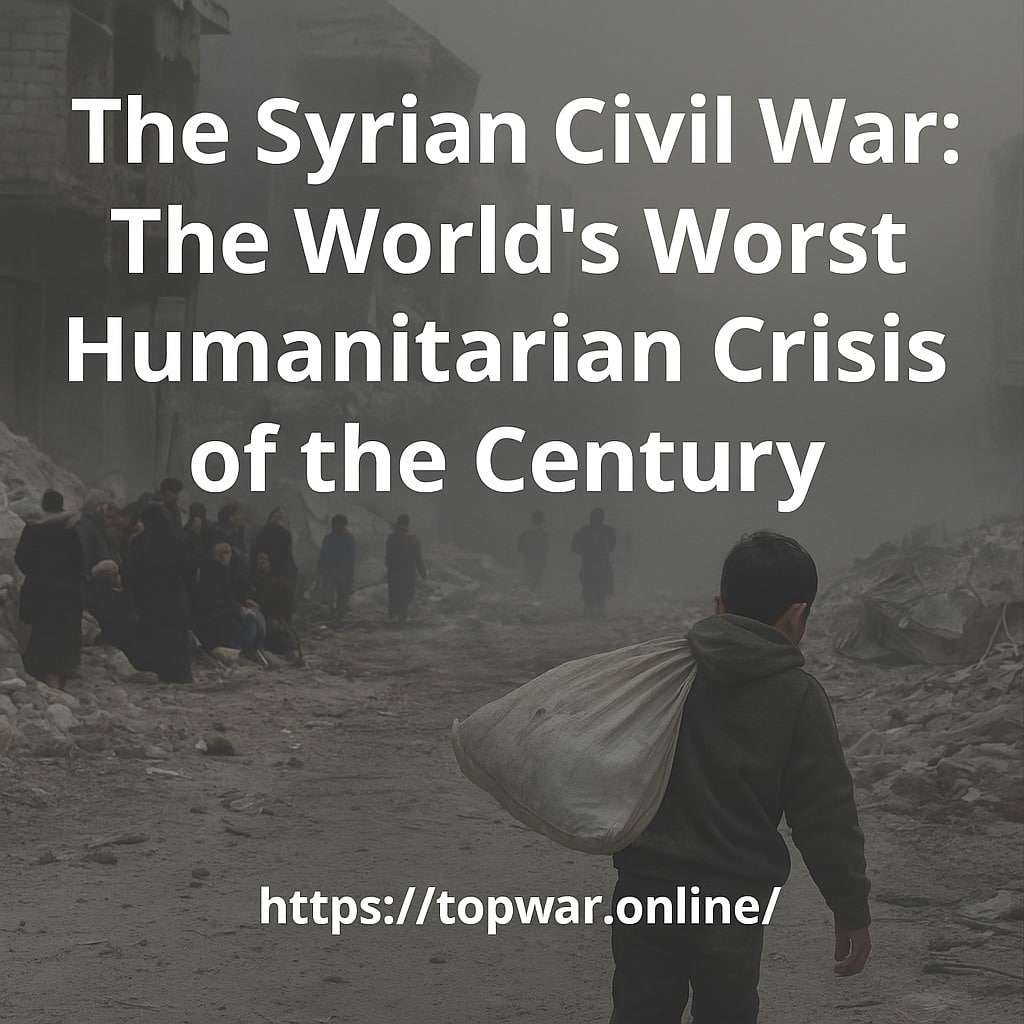
Inside Syria, civilians endure constant danger from bombings, sieges, and food shortages. Cities like Aleppo and Homs were reduced to rubble, and entire generations of children have grown up knowing only war.
The United Nations has called Syria “the world’s worst humanitarian crisis,” citing widespread violations of international law, deliberate targeting of hospitals and schools, and the use of starvation as a weapon of war.
The Battle for Aleppo
The Battle of Aleppo became one of the most symbolic and devastating confrontations of the war.
Once Syria’s largest city and economic hub, Aleppo was divided between government and rebel forces from 2012 to 2016. Years of relentless airstrikes and street battles left much of the city in ruins. Civilians trapped in rebel-held areas faced constant bombardment with little access to food or medical care.
By late 2016, with Russian air support and Iranian-backed militias, the Syrian government recaptured Aleppo. The fall of the city marked a major turning point, signaling Assad’s consolidation of power in western Syria but at a catastrophic humanitarian cost.
The Kurdish Struggle and Autonomous Administration
While the main war raged between Assad’s forces and rebels, Kurdish groups in northern Syria carved out a self-administered region known as Rojava. Led by the Syrian Democratic Forces (SDF) and the Kurdish YPG militia, they became crucial allies of the U.S. in the fight against ISIS.
Rojava implemented a system of local governance based on gender equality, secularism, and grassroots democracy. However, Turkey viewed the Kurdish autonomy as a national security threat and launched several cross-border operations to prevent the creation of a continuous Kurdish-controlled zone along its border.
The Kurdish struggle remains one of the most complex subplots of the Syrian conflict, balancing between survival, autonomy, and international pressure.
The Decline of ISIS and the Changing Landscape
By 2019, the ISIS caliphate was effectively dismantled. U.S.-backed Kurdish forces captured the last ISIS stronghold in Baghouz, ending the group’s territorial control. However, ISIS remnants continued to operate underground, launching sporadic attacks across the region.
With ISIS weakened, the Syrian conflict gradually shifted toward political maneuvering. The Assad regime, supported by Russia and Iran, regained control of most major population centers. Yet large parts of northern and eastern Syria remained outside government control, held by Kurdish forces and various rebel groups.
International Diplomacy and Peace Efforts
Over the years, multiple international efforts sought to end the war, but most failed due to competing interests.
The United Nations sponsored several rounds of peace talks in Geneva, aiming for a political transition, constitutional reforms, and elections. Meanwhile, Russia, Turkey, and Iran launched their own parallel peace initiative through the Astana process.
Despite numerous cease-fire agreements, fighting repeatedly resumed. The lack of unified international pressure and Assad’s military advantage made meaningful political compromise elusive.
The Role of the United Nations and Aid Organizations
Throughout the conflict, the UN and numerous humanitarian organizations have worked tirelessly to provide aid to millions of Syrians. However, access to besieged areas has often been restricted by both government and rebel forces.
Organizations like the International Red Cross, UNICEF, and the World Food Programme have delivered food, medicine, and shelter under extremely dangerous conditions. Yet funding shortfalls and political obstacles have limited their reach.
The crisis also fueled a major debate about the responsibility of the international community to protect civilians. The concept of “Responsibility to Protect” (R2P) faced severe criticism as world powers failed to prevent mass atrocities in Syria.
The Refugee Crisis and Global Impact
The Syrian refugee crisis reshaped global politics and humanitarian policy. Millions of Syrians sought refuge in Europe, triggering intense political debates about immigration, integration, and national security.
Countries like Germany accepted large numbers of refugees, while others tightened their borders. The crisis fueled the rise of populist movements across Europe and influenced elections and foreign policies.
Beyond Europe, the displacement of Syrians has affected the demographics and economies of neighboring countries. Lebanon’s population increased by over a quarter due to refugees, while Turkey now hosts more than 3.5 million Syrians — the largest refugee population in the world.
The Economic Destruction of Syria
The economic cost of the Syrian Civil War is immeasurable. Infrastructure, industry, and agriculture have been destroyed. The country’s GDP has fallen by more than 60 percent since 2010.
Oil fields were captured and recaptured by various factions, depriving the state of revenue. Reconstruction costs are estimated in the hundreds of billions of dollars. With ongoing sanctions and political isolation, rebuilding remains a distant dream.
The Current Situation and Future Outlook
As of the mid-2020s, Bashar al-Assad remains in power, having weathered years of rebellion and international pressure. His government controls most of the country, but large parts of northern and eastern Syria remain outside his authority.
The humanitarian situation is still dire. Millions of Syrians live in poverty, and basic services such as healthcare, electricity, and education remain limited. International aid continues, but without a lasting political settlement, recovery remains uncertain.
The world has largely shifted its attention elsewhere, yet the suffering in Syria continues. The war’s legacy endures through its refugees, its shattered cities, and its lessons about human resilience and global indifference.
Lessons from the Syrian Civil War
- Peaceful protests can spiral into catastrophic wars when governments respond with violence instead of reform.
- Foreign intervention often prolongs conflicts instead of resolving them.
- The international community’s inaction can turn local crises into global humanitarian disasters.
- Sectarianism and extremism thrive in the vacuum of failed governance.
- Reconstruction and reconciliation are impossible without justice and accountability.
Conclusion
The Syrian Civil War is not just a story of political conflict; it is a story of immense human suffering and endurance. Entire generations have been scarred by violence, displacement, and loss. Cities once filled with life have been reduced to rubble, and millions remain without homes or hope.
It is also a story of global failure — the failure to stop atrocities, to protect the innocent, and to uphold international law. Yet amid the tragedy, there are stories of resilience, compassion, and survival that continue to inspire.
As the world reflects on the war that became the century’s worst humanitarian crisis, one message stands clear: peace is not achieved through power alone but through justice, empathy, and a commitment to humanity above politics.