

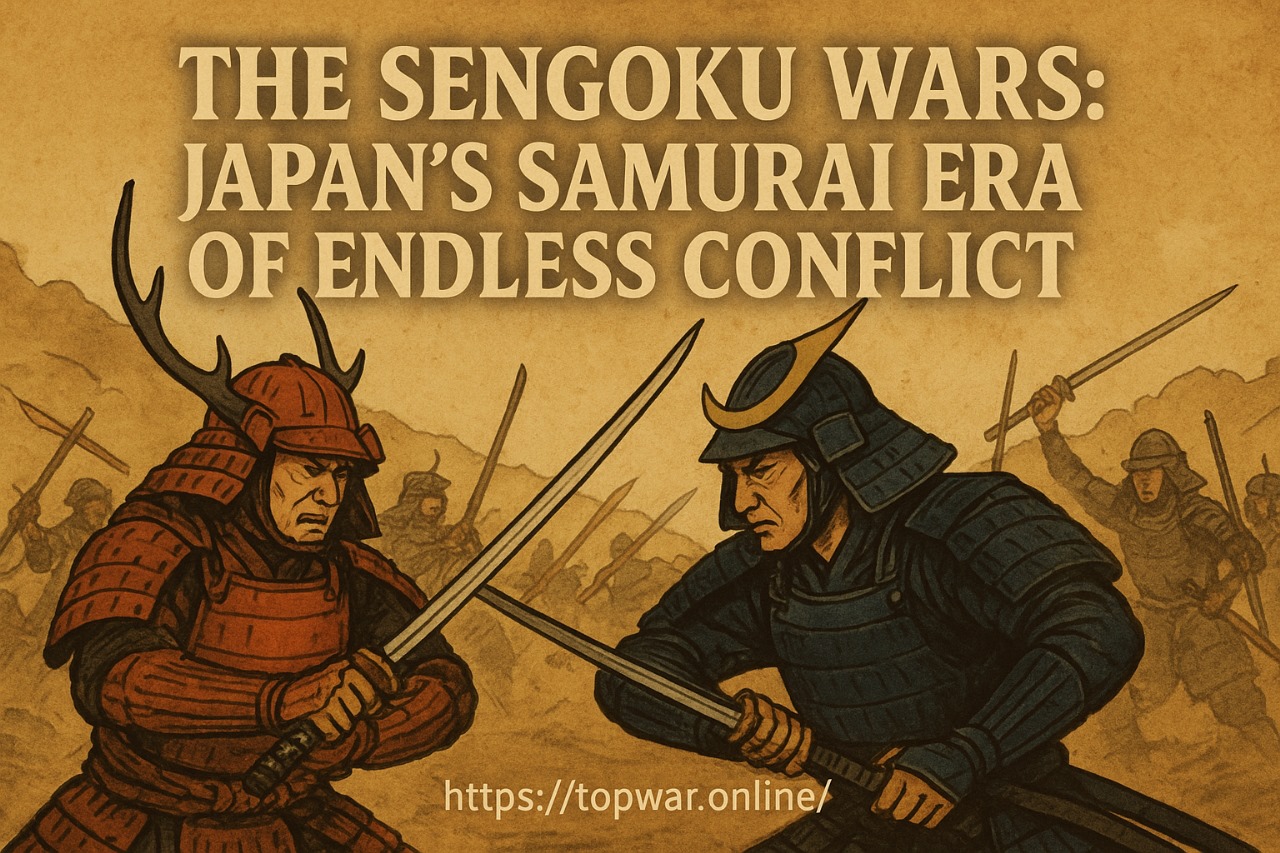
Introduction: A Century of Chaos That Forged a New Japan
The Sengoku period, often called the “Age of Warring States,” stands as one of the most violent and transformative eras in Japanese history. Lasting from the mid-15th century to the early 17th century, this period was defined by endless warfare, shifting alliances, ruthless ambition, and the rise of legendary samurai warlords. Japan fractured into dozens of competing domains, each ruled by powerful daimyō who fought relentlessly for land, power, and control of the Shogunate. The collapse of central authority created a political vacuum, plunging the country into 150 years of chaos. Yet, from this turmoil emerged some of Japan’s greatest warriors, strategists, and unifiers. The Sengoku era shaped the identity of the samurai, introduced groundbreaking military strategies, and eventually led to the unification of Japan under a strong centralized government. It is a story of brutality, honor, betrayal, and transformation that continues to inspire films, books, games, and cultural memory worldwide.
The Collapse of Central Authority and the Start of the Sengoku Era
The Sengoku Wars began when the Ashikaga Shogunate weakened significantly during the 15th century. The central government had long relied on the delicate balance of power between regional clans, but when the shogunate failed to control the increasingly independent daimyō, the entire system unraveled. The Ōnin War (1467–1477) marked the dramatic turning point. What started as a succession dispute escalated into widespread destruction across Kyoto, leaving the capital in ruins and the nation without strong leadership. With the Ashikaga Shogunate powerless, regional lords became independent rulers, each building their own armies, fortresses, alliances, and political systems. The result was a fragmented Japan, where rivalry replaced unity and every clan fought to expand its territory. The country became a battlefield where ambition and survival dictated every decision.
Rise of the Daimyō: The Warlords Who Controlled Japan
During the Sengoku period, power shifted from the shogun to the daimyō—local warlords who controlled sprawling provinces. Daimyō were far more than military leaders; they were political administrators, economic managers, and rulers of their mini-states. They implemented tax systems, developed infrastructure, trained armies, and created laws within their territories. Their ultimate goal was survival and expansion, either through war or strategic alliances. Some daimyō, like the Takeda, Uesugi, Mori, and Shimazu clans, built powerful regional empires. Others rose from humble origins, proving that in this era, social mobility could come through military skill and strategic brilliance. The rise of the daimyō redefined Japanese politics. Loyalty was no longer tied to a distant shogun but to a local warlord whose power came from battlefield success. The daimyō’s constant conflicts created the dynamic, unpredictable landscape that defined the Sengoku era.
Samurai Culture in the Age of War
The Sengoku era is often romanticized as the golden age of the samurai, and while samurai did embody ideals of honor and discipline, the realities of war forced them to evolve. Samurai were professional warriors bound by loyalty to their daimyō. Their code of bushidō emphasized bravery, duty, and sacrifice, but during the conflicts of this period, survival and strategy often outweighed formal codes. Samurai armor became more functional, swords and spears were refined, and battlefield hierarchies developed more clearly. Samurai also learned to adapt to the increasing use of ashigaru (foot soldiers), who played a crucial role in large-scale warfare. Many legendary tales of courage, betrayal, loyalty, and sacrifice originated in this period, shaping the image of the samurai for centuries.
The Evolution of Warfare: Castles, Firearms, and Strategy
The Sengoku Wars revolutionized Japanese warfare. The introduction of firearms by Portuguese traders in 1543 changed the battlefield forever. Daimyō quickly adopted arquebuses and muskets, leading to new formations and tactical innovations. Battles grew larger and more complex, requiring strategic thinking beyond traditional sword and spear combat. Additionally, castle building evolved dramatically. Fortresses were no longer simple wooden structures but massive stone castles designed to withstand sieges and artillery fire. Iconic castles like Osaka, Himeji, and Azuchi showcased advanced engineering, with multi-layered defenses, hidden passages, and strategic layouts. Military tactics such as rotating musket volleys, night attacks, and psychological warfare became common. The Sengoku era marked Japan’s transition from medieval warfare to early modern military organization.
The Legend of Oda Nobunaga: The First Great Unifier
Oda Nobunaga emerged as one of the most powerful and revolutionary leaders of the Sengoku period. Rising from a relatively minor clan, he shocked more established daimyō with his bold strategies and ruthless efficiency. Nobunaga modernized his army, embraced firearms, and used innovative tactics to defeat larger opponents. His victory at the Battle of Okehazama in 1560, where he crushed the powerful Imagawa clan with a surprise attack, catapulted him to national prominence. Nobunaga was not just a military genius; he was a political visionary who sought to end the fragmented system that kept Japan in constant war. He increased economic stability, promoted free trade, reduced the power of Buddhist warrior monks, and encouraged cultural development. His ambition was clear: unify Japan under his rule. Although he succeeded in conquering large parts of the country, his rise created enemies who resented his power and radical reforms.
The Fall of Nobunaga: Betrayal at Honnō-ji
In 1582, Oda Nobunaga’s remarkable rise came to a shocking end. One of his trusted generals, Akechi Mitsuhide, betrayed him during a visit to the Honnō-ji temple in Kyoto. Nobunaga, caught entirely off guard, was forced to commit seppuku as the temple burned around him. Mitsuhide’s betrayal remains one of the most mysterious events in Japanese history, with various theories about his motives ranging from personal jealousy to political grievances. Nobunaga’s death created a sudden power vacuum, plunging the country back into uncertainty. However, his legacy lived on through his revolutionary reforms and the leaders who continued his mission to unify Japan.
Toyotomi Hideyoshi: The Peasant Who Became Japan’s Ruler
After Nobunaga’s death, one of his most loyal generals, Toyotomi Hideyoshi, avenged him swiftly. Hideyoshi defeated Akechi Mitsuhide at the Battle of Yamazaki, then consolidated power with remarkable speed and skill. What makes Hideyoshi extraordinary is his background. Born into a poor peasant family, he rose through the ranks entirely through talent, ambition, and strategic brilliance—an almost unheard-of achievement in samurai-dominated Japan. Hideyoshi completed much of the unification that Nobunaga had started. He subdued rival clans, reformed the social system, and implemented nationwide surveys to stabilize taxation and governance. Hideyoshi also enforced a rigid social hierarchy, freezing social mobility and ensuring that samurai, farmers, artisans, and merchants stayed within their classes. Although he sought to expand Japan’s influence by invading Korea, these campaigns ultimately failed. Yet, his role in unifying Japan remains a crucial milestone in the Sengoku era.
Tokugawa Ieyasu: The Final Unifier and Founder of the Shogunate
After Hideyoshi’s death, Japan once again edged toward conflict. His young son Hideyori was too weak to rule, leading to divisions among the daimyō. The stage was set for the rise of Tokugawa Ieyasu, a strategic and patient warlord who had long navigated the turbulent politics of the Sengoku era. The decisive moment came at the Battle of Sekigahara in 1600, where Ieyasu defeated rival forces and secured control over Japan. Three years later, he was appointed shogun, marking the official beginning of the Tokugawa Shogunate—one of the longest and most stable governments in Japanese history. The establishment of Tokugawa rule is considered the end of the Sengoku Wars. Ieyasu’s governance focused on stability, strict social order, and isolationist policies to prevent future conflict. His dynasty ruled Japan for more than 250 years, bringing an end to centuries of internal warfare.
Life During the Sengoku Period: Hardship, Duty, and Fear
For ordinary people, the Sengoku era was a time of constant uncertainty. Villages were destroyed in battles, crops were seized by armies, and taxes were harsh as daimyō funded their military campaigns. Peasants lived under the strict control of their local lords, often forced into labor or military service. Yet, despite the hardship, society continued to function. Farmers grew essential crops, merchants transported goods between regions, and artisans crafted weapons, armor, and tools essential for daily life and warfare. The constant conflict stimulated economic activity in unexpected ways, particularly in castle towns that became centers of commerce. Life was difficult, but it also fostered resilience, ingenuity, and cultural development.
The Role of Religion and Warrior Monks
Religion played a significant role in the Sengoku era, influencing both politics and warfare. Buddhist monasteries, especially the warrior monk sects known as sōhei, often controlled vast territories and participated in battles. Some monasteries allied with daimyō, while others resisted powerful warlords like Oda Nobunaga. Nobunaga’s destruction of the Enryaku-ji monastery on Mount Hiei stands as one of the most infamous examples of his ruthless approach to suppressing religious military influence. At the same time, new religious movements emerged, offering hope to common people suffering through endless conflict. This mix of spiritual belief and military power added another layer of complexity to the Sengoku Wars.
The Influence of Portuguese Traders and Foreign Contact
The arrival of Portuguese traders in 1543 introduced new technology, ideas, and trade opportunities to Japan. The most significant contribution was the firearm, which changed Japanese military tactics permanently. Daimyō who adopted firearms early gained a major advantage over their rivals. Foreign trade also brought new goods, including silk, medicines, and exotic items that influenced Japanese culture. Christian missionaries, particularly the Jesuits, converted thousands of Japanese, including some daimyō, creating both opportunities and tensions. While foreign contact enriched Japanese life, it eventually led later shoguns to adopt isolationist policies to preserve traditional culture and prevent Western influence from spreading too deeply.
Economy and Society in a War-Torn Japan
Despite the chaos of war, the Sengoku period experienced economic growth. Agricultural improvements increased crop production, allowing daimyō to support larger armies. Trade flourished between regions, as merchants transported rice, metal, fabric, weapons, and luxury goods. Castle towns grew into major economic centers, with markets, artisans, and traders contributing to urban development. This economic expansion laid the foundation for Japan’s transformation in the following centuries. At the same time, the rigid class system, reinforced heavily by Hideyoshi, shaped Japanese society for generations. Although social mobility became restricted, the stability it offered helped maintain order during the transition into the Tokugawa era.
Art, Culture, and Tea Ceremony: A Cultural Bloom Amid War
Even during a period of warfare, Japanese culture flourished. The Sengoku era saw the rise of the tea ceremony, which became a symbol of discipline, refinement, and inner peace amid chaos. Influenced by masters like Sen no Rikyū, the tea ceremony emphasized simplicity and harmony, offering samurai a moment of calm in a violent world. Castle architecture also evolved, combining practicality with beauty through gardens, artwork, and intricate interior designs. Noh theater, poetry, and calligraphy thrived, reflecting the complex blend of elegance and brutality that defined the era. Warfare did not extinguish culture; instead, it created an environment where philosophy and art provided meaning and balance.
Women in the Sengoku Era
Although often overlooked, women played important roles during the Sengoku period. Samurai wives managed estates, oversaw finances, defended castles, and maintained clan operations when men were at war. Some women, such as Ii Naotora and Tachibana Ginchiyo, even commanded troops and ruled domains. Their resilience and leadership highlight the important, though often hidden, contributions women made to the survival and success of their clans.
The End of the Sengoku Period and the Birth of a New Japan
The Sengoku Wars officially ended with the rise of Tokugawa Ieyasu and the establishment of the Tokugawa Shogunate in 1603. Over the next two centuries, Japan enjoyed remarkable peace, stability, and isolation under Tokugawa rule. The daimyō were tightly controlled, social classes were strictly regulated, and foreign influence was restricted. This long period of peace, known as the Edo period, allowed Japan to develop culturally, economically, and politically without the devastation of constant warfare. The Sengoku era, though violent and chaotic, was the crucible that forged the foundations of modern Japan.
Conclusion: A Legacy of War, Honor, and Transformation
The Sengoku Wars were far more than a series of battles—they were a defining era that reshaped Japan’s identity, politics, warfare, and culture. It was a time of extraordinary ambition, breathtaking strategy, and relentless conflict, driven by the dreams of samurai warlords who sought to unify a divided nation. From the destruction of the Ashikaga Shogunate to the rise of Nobunaga, Hideyoshi, and Ieyasu, the Sengoku period tells a complex and inspiring story of resilience and transformation. The chaos ultimately gave birth to a unified Japan, ending centuries of civil war and opening the path to a new age of peace and stability. The era remains one of the most powerful and beloved chapters in Japanese history, forever shaping the world’s perception of samurai culture, strategy, and honor.