

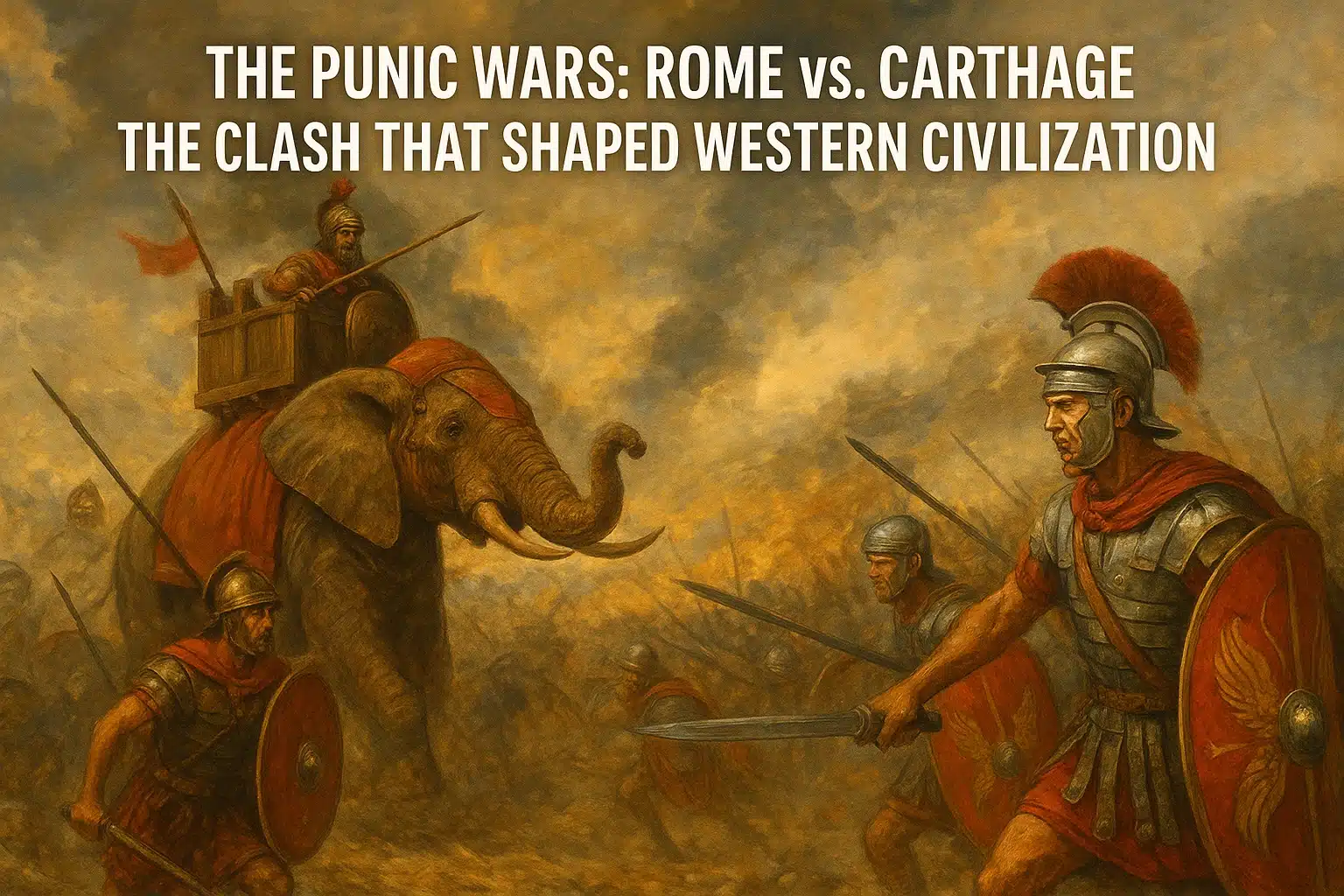
Introduction: Two Superpowers of the Ancient World
In the 3rd and 2nd centuries BCE, the Mediterranean world witnessed one of the most epic rivalries in human history the Punic Wars between Rome and Carthage. These wars were not just battles for territory, but a struggle between two civilizations with competing visions of power, trade, and destiny.
Rome, the rising republic of disciplined soldiers and iron determination, faced Carthage, the wealthy maritime empire of North Africa, famous for its naval might and commercial dominance. Over a span of more than a century, from 264 BCE to 146 BCE, three Punic Wars reshaped the ancient world and laid the foundation for Rome’s domination of the Western world.
The Origins of Rivalry: Rome and Carthage Before the Wars
Before the wars erupted, Carthage and Rome were both expanding powers. Carthage, located in modern-day Tunisia, was founded by Phoenician settlers and had become the richest trading city in the Mediterranean. Its empire spanned North Africa, parts of Spain, and several key islands, including Sardinia and Corsica. Rome, on the other hand, had recently unified the Italian Peninsula and was turning its gaze outward.
The spark came when both powers vied for control over Sicily, a strategically crucial island in the heart of the Mediterranean. Control of Sicily meant control over sea routes, trade, and influence across the region. The stage was set for the First Punic War, marking the beginning of one of the greatest rivalries in ancient history.
The First Punic War (264–241 BCE): The Struggle for Sicily
The Battle for Naval Supremacy
The First Punic War began in 264 BCE when Roman forces intervened in a dispute between local powers in Sicily. At first, Rome had no navy and little experience at sea, while Carthage possessed one of the most powerful fleets in the world. However, Rome’s adaptability soon changed the tide. By capturing a Carthaginian ship and reverse-engineering its design, the Romans built their own fleet and trained thousands of sailors.
To offset their lack of naval experience, the Romans introduced a new innovation the corvus, a boarding bridge that allowed Roman soldiers to turn sea battles into hand-to-hand combat. This invention helped Rome win several major naval engagements and gradually push Carthage out of Sicily.
The Aftermath: Rome’s First Overseas Province
After over two decades of fierce fighting, Carthage was forced to surrender in 241 BCE. The peace treaty required Carthage to pay a massive indemnity and cede control of Sicily to Rome. This marked Rome’s first overseas province a crucial milestone in its rise as an empire. However, Carthage’s defeat was not the end. It was merely the prelude to a far deadlier confrontation.
The Second Punic War (218–201 BCE): Hannibal’s Revenge
The Rise of Hannibal Barca
The Second Punic War is one of the most legendary conflicts in military history, largely because of Hannibal Barca, Carthage’s brilliant and fearless general. Born into a family of warriors, Hannibal had sworn eternal hatred against Rome from childhood. Determined to avenge Carthage’s humiliation, he devised an audacious plan to invade Italy itself and bring the fight to Rome’s doorstep.
Crossing the Alps: A Feat of Courage and Strategy
In 218 BCE, Hannibal led a massive army including war elephants from Spain, across the Pyrenees, through southern Gaul, and over the snow-covered Alps into northern Italy. The journey was brutal; thousands of soldiers and animals perished. Yet, Hannibal’s arrival in Italy stunned the Romans. Few believed such a feat was possible. His invasion marked one of the boldest strategic maneuvers in ancient warfare.
Hannibal’s Triumphs: Trebia, Trasimene, and Cannae
Once in Italy, Hannibal unleashed a series of devastating victories. At the Battle of Trebia (218 BCE) and Lake Trasimene (217 BCE), he crushed Roman forces using superior tactics. But his most famous victory came in 216 BCE at Cannae, where Hannibal executed a perfect double-envelopment maneuver, annihilating nearly 70,000 Roman soldiers in a single day. This battle remains one of the most studied military engagements in history a masterpiece of battlefield strategy.
Rome’s Resilience and the Counterattack
Despite catastrophic losses, Rome refused to surrender. The Republic’s strength lay in its discipline, unity, and ability to raise new armies. Under Fabius Maximus, known as “The Delayer,” Rome adopted a strategy of attrition avoiding direct confrontation with Hannibal and focusing on cutting off his supplies. This slow but effective approach gradually weakened Carthage’s position in Italy.
The Turning Point: Scipio Africanus and the Battle of Zama
As the war dragged on, a young Roman general named Publius Cornelius Scipio emerged as a rising star. Scipio launched an offensive in Spain, capturing key Carthaginian strongholds and eventually invading North Africa itself. This forced Hannibal to return home to defend Carthage.
In 202 BCE, the two greatest generals of their time faced off at the Battle of Zama in modern-day Tunisia. Scipio’s disciplined legions, supported by Numidian cavalry, decisively defeated Hannibal’s army. The Carthaginian war elephants were neutralized, and Hannibal’s tactics were outmaneuvered for the first time. Carthage’s defeat marked the end of the Second Punic War and solidified Rome as the supreme power in the western Mediterranean.
The Third Punic War (149–146 BCE): The Destruction of Carthage
Rome’s Relentless Revenge
Although Carthage had been weakened, it slowly began to recover economically after the Second Punic War. This resurgence alarmed Roman leaders, especially the influential senator Cato the Elder, who ended every speech with the words: “Carthago delenda est” “Carthage must be destroyed.”
In 149 BCE, Rome declared war again, determined to eliminate its old rival once and for all. The Third Punic War was short but brutal. The Romans besieged Carthage for three years, cutting off supplies and relentlessly bombarding the city.
The Fall of Carthage: A City Erased from History
In 146 BCE, Roman forces finally breached Carthage’s walls. The city was subjected to horrific destruction its buildings were burned, its people killed or enslaved, and its land allegedly sown with salt (a symbolic gesture meaning it would never rise again). Carthage, once the queen of the Mediterranean, was reduced to ashes. Rome now ruled unchallenged.
Economic and Cultural Impact of the Punic Wars
The Punic Wars transformed the Mediterranean world politically, economically, and culturally. Rome’s victory opened the door to massive wealth from slaves and trade routes to agricultural lands in North Africa and Spain. The republic evolved into a Mediterranean superpower, controlling sea routes, grain supplies, and commerce.
However, the wars also deepened social inequality. The influx of slaves devastated small Roman farmers, leading to the concentration of land in the hands of the elite. These changes would later contribute to political unrest and the eventual fall of the Roman Republic.
Military Evolution: From Citizen Soldiers to Empire Builders
The Punic Wars revolutionized Roman warfare. The need for strong navies, fortified cities, and long-term campaigns led to innovations in logistics, shipbuilding, and strategy. Rome’s armies became professional and more disciplined. The experiences from these wars forged a new generation of Roman generals who would later conquer Greece, Gaul, and beyond. Without the lessons learned against Carthage, Rome might never have built its global empire.
The Legacy of Carthage: A Lost Civilization Remembered
Though Carthage was destroyed, its legacy survived through its maritime achievements, trade networks, and contributions to navigation. The Carthaginians were brilliant merchants and explorers, venturing beyond the Strait of Gibraltar into the Atlantic. Even Rome, despite annihilating Carthage, later rebuilt the city under Julius Caesar and Augustus, turning it into a thriving Roman colony. Carthage eventually became one of the most prosperous cities of the Roman Empire a testament to its enduring resilience.
Rome’s Ascendancy: The Birth of a Mediterranean Empire
The destruction of Carthage left Rome without rivals. The Republic emerged as the unchallenged master of the Mediterranean, paving the way for centuries of Roman domination. This victory not only shaped Rome’s imperial destiny but also influenced Western civilization’s political and cultural trajectory. The ideals of governance, military discipline, and civic duty that defined Rome were all strengthened through these wars.
The Punic Wars and Their Influence on Western Civilization
Historians regard the Punic Wars as a turning point in Western history. The conflict between Rome and Carthage demonstrated the triumph of organization and discipline over wealth and naval power. It also introduced new models of governance, warfare, and economic expansion that influenced later European empires. Rome’s rise after Carthage’s fall set the stage for the spread of Latin language, Roman law, and Western cultural ideals across Europe, Africa, and the Middle East.
Lessons from the Punic Wars
The Punic Wars teach timeless lessons about ambition, rivalry, and resilience. They show how determination and unity can overcome even the most formidable adversary. Rome’s persistence in the face of early defeats reflects the power of long-term strategy over short-term glory. Meanwhile, Carthage’s fall warns of the dangers of underestimating one’s enemy and relying too heavily on wealth over strength. These lessons remain relevant in politics, leadership, and global affairs even today.
Conclusion: The Clash That Forged an Empire
The Punic Wars were more than a series of military conflicts they were a clash of civilizations that defined the course of Western history. From Hannibal’s audacious campaigns to Rome’s unyielding determination, the wars showcased the extremes of human courage, ambition, and endurance. In the ashes of Carthage, Rome built an empire that would dominate the known world for centuries.
1. The Geopolitical Importance of the Mediterranean Sea
The Mediterranean Sea was the lifeblood of ancient civilizations, serving as the main artery for trade, communication, and power projection. Control over this region meant dominance over the ancient world’s economy and politics. For Carthage, a city founded by Phoenician merchants, maritime supremacy was both its identity and survival strategy. Rome, initially a land-based power, realized that it could never rival Carthage without mastering the seas. Thus, the Punic Wars were as much about naval control as they were about territorial expansion. The struggle for the Mediterranean transformed Rome from a local republic into a global empire.
2. Carthaginian Society and Strength: A Maritime Powerhouse
Carthage was a unique civilization built on trade and enterprise. Its navy and merchant fleet connected distant colonies from Spain to North Africa. The city’s wealth came from metals, textiles, and agriculture, while its political system was a mix of monarchy, aristocracy, and democracy. Unlike Rome, Carthage relied heavily on mercenarieshired soldiers from Numidia, Iberia, and Gaul. While this gave Carthage a diverse army, it also made loyalty fragile, as mercenaries fought for payment rather than patriotism. This structural weakness would later prove disastrous when facing Rome’s citizen-soldiers driven by civic duty.
3. Rome’s Political Structure: Unity Through Discipline
Rome’s republican system provided it with remarkable internal stability during times of war. The Senate, dominated by patricians, coordinated war strategies, while elected consuls led armies. The Roman concept of “mos maiorum”the ancestral wayinstilled duty, loyalty, and discipline in every citizen. Every Roman male owed military service to the state, which created a personal bond between soldier and nation. Unlike Carthage, Rome’s armies were not hired; they were an extension of its political will. This unity of purpose allowed Rome to recover from catastrophic defeats that would have broken any other state.
4. Hannibal’s Genius: The Mind of a Master Strategist
Hannibal Barca is remembered as one of history’s greatest military minds. His ability to outthink larger and better-equipped Roman armies remains a subject of study in modern military academies. Hannibal’s strategy was psychological as much as tactical. By repeatedly defeating Roman armies on their home soil, he aimed to shatter Rome’s confidence and provoke its allies to revolt. His combination of speed, deception, and terrain mastery turned Italy into a battlefield of constant surprise. However, despite his tactical brilliance, Hannibal lacked the resources to capture Rome itselfa crucial limitation that eventually doomed his campaign.
5. The Human Cost of the Punic Wars
Behind the glory of Rome’s triumphs and Carthage’s heroics lay immense human suffering. Hundreds of thousands of soldiers perished in brutal battles, and countless civilians were displaced or enslaved. The wars drained the economies of both states and reshaped entire populations. Farmers in Italy lost their lands, Carthaginian families were torn apart, and entire cities were razed. The sheer scale of destruction during the Punic Wars made them some of the bloodiest conflicts in the ancient worldforeshadowing the empire-building wars of later centuries.
6. The Role of Numidia and Spain: The Silent Kingmakers
Both Numidia (modern Algeria) and Spain played pivotal roles in the Punic Wars. Spain provided Carthage with silver mines that financed its armies, while Numidian cavalry became a decisive factor in several battles. Initially allied with Carthage, Numidian kings later switched allegiance to Rome under Scipio Africanus. This betrayal devastated Carthage’s military power. Control of Spain also became a turning point, as Rome’s conquest of Iberia gave it vast resources and strategic bases for further campaigns. These alliances highlight how regional powers influenced the larger Roman-Carthaginian conflict.
7. The Transformation of Roman Naval Power
Rome’s navy was practically non-existent before the First Punic War, yet by the end of it, Rome had developed one of the most formidable fleets in the ancient world. The construction of hundreds of ships in record time demonstrated Rome’s organizational strength and resourcefulness. The introduction of the corvusa boarding bridge that converted naval battles into infantry skirmishesneutralized Carthage’s superior seamanship. This innovation not only helped Rome dominate the seas but also set the stage for its future as a maritime empire. It was a crucial example of Roman adaptability in warfare.
8. Economic Warfare: Trade, Blockades, and Strategy
Beyond the battlefields, the Punic Wars were also fought through economic warfare. Carthage’s wealth depended on open trade routes, while Rome aimed to choke its rival’s commerce through blockades and territorial conquests. Rome’s control of Sicily, Sardinia, and Spain effectively strangled Carthage’s economy. Meanwhile, Carthaginian privateers harassed Roman supply lines. The wars showed that victory was not only achieved by armies but also by cutting off an enemy’s lifelinecontrol of trade and resources. This economic struggle marked the beginning of a more sophisticated form of warfare that shaped imperial strategy for centuries.
9. The Psychological Warfare Between Rome and Carthage
The Punic Wars were also a battle of morale and propaganda. Roman orators and historians depicted Carthage as a greedy, treacherous poweran enemy of civilization. Carthage, in turn, portrayed Rome as an aggressive imperialist threatening free trade. This propaganda war helped both sides maintain domestic unity. For Rome, it created a sense of divine mission, portraying victory as fate’s will. For Carthage, it justified resistance even in the face of despair. The ideological conflict transformed a regional rivalry into a civilizational strugglea war for the soul of the Mediterranean world.
10. Women and Civilians in the Punic Wars
While the battlefield stories dominate history books, the role of women and civilians during the Punic Wars is equally significant. Roman women supported the war effort by managing estates, producing supplies, and maintaining morale at home. In Carthage, women took part in defense efforts during the siege, even donating jewelry to fund the army. Civilians bore the brunt of destruction; entire Carthaginian families fought to the last man during the city’s final siege. These acts of courage highlight how deeply the wars affected every layer of society, not just the soldiers in combat.
11. Archaeological Evidence and Modern Discoveries
Modern archaeology continues to shed light on the Punic Wars. Excavations in Tunisia, Sicily, and Spain have uncovered Carthaginian coins, Roman weapons, and shipwrecks that confirm ancient accounts. The discovery of the Battle of the Aegates Islands wrecks off Sicily has provided unprecedented insight into naval warfare of the time. Ruins of Carthage still bear traces of Roman destruction, including burnt layers and weapon fragments. These findings not only validate historical texts by Polybius and Livy but also bring the ancient conflict to life, connecting modern audiences with one of history’s most transformative wars.
12. The Eternal Symbolism of Rome vs. Carthage
The rivalry between Rome and Carthage transcends its time. It symbolizes the eternal struggle between ambition and survival, order and chaos, land and sea. Many historians see echoes of the Punic Wars in later conflicts from the Cold War rivalries to modern geopolitical power struggles. Rome’s rise after Carthage’s fall represents how persistence, organization, and national unity can triumph over wealth and opportunity. The destruction of Carthage serves as a stark reminder that even the mightiest civilizations can perish when hubris replaces humility. The Punic Wars thus remain an enduring lesson in the balance of power and the cost of empire.