

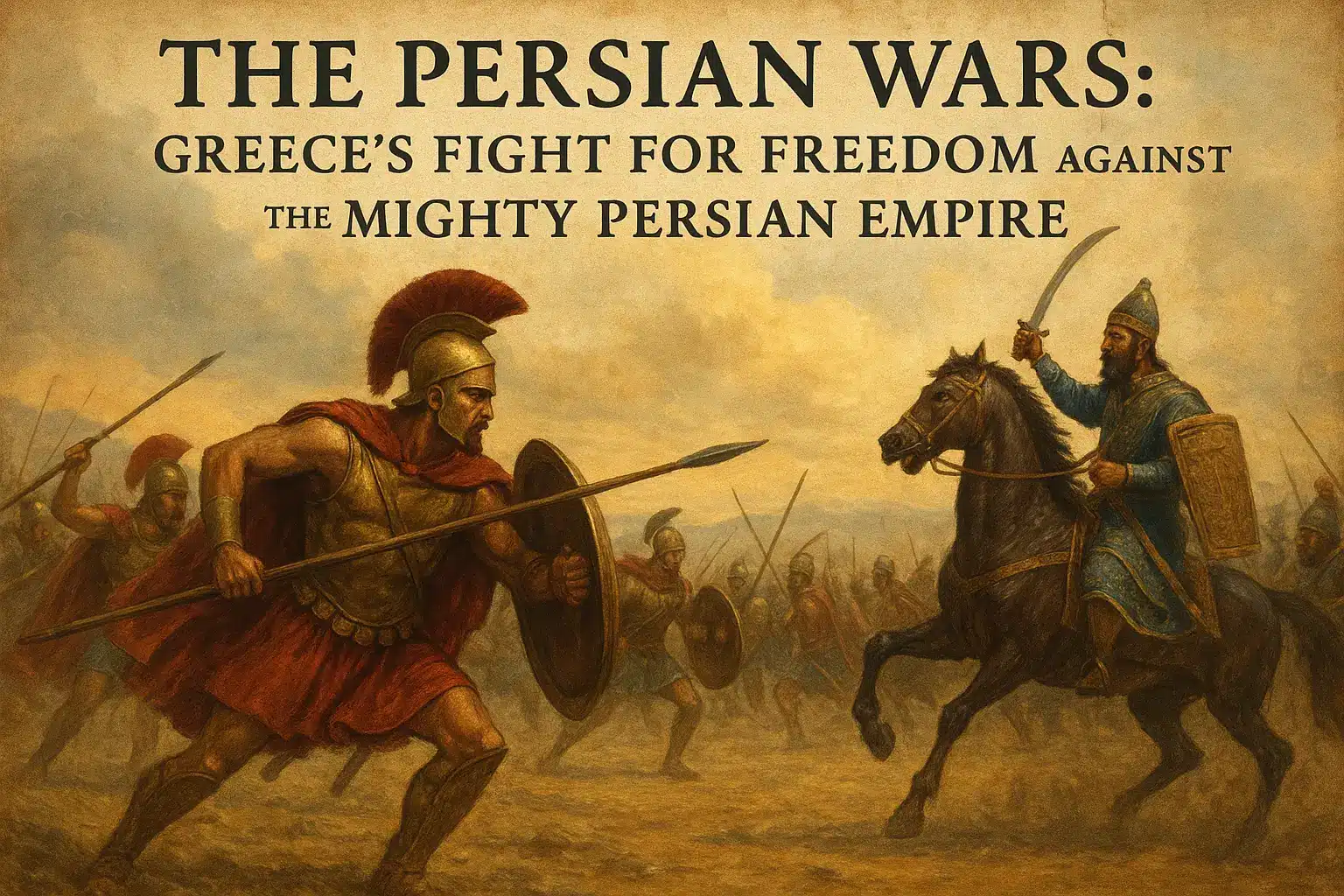
Introduction: A Defining Clash Between East and West
In the vast panorama of ancient history, few wars have shaped the destiny of civilizations as profoundly as The Persian Wars. Fought between 499 BCE and 449 BCE, these conflicts marked a dramatic confrontation between the democratic Greek city-states and the autocratic might of the Persian Empire then the most powerful realm on Earth. This was not merely a struggle for land or supremacy, but a contest of ideals freedom versus tyranny, self-rule versus imperial domination. The outcome of these wars determined the course of Western civilization, ensuring that the ideals of democracy, philosophy, and liberty would flourish. For the Greeks, victory meant survival. For Persia, defeat marked the limit of its imperial ambitions. From the burning plains of Marathon to the narrow waters of Salamis, the Persian Wars remain one of history’s most inspiring stories of courage and unity against impossible odds.
The Rise of the Persian Empire
Before the first arrow was fired or the first trireme set sail, the world already trembled at the name of Persia. Founded by Cyrus the Great in the mid-6th century BCE, the Persian Empire was a marvel of administration, culture, and sheer size. Stretching from the Indus River in the east to the Aegean Sea in the west, and from Egypt to Central Asia, it united millions under a single banner. Under Cyrus and his successors Cambyses II and Darius I Persia became the world’s first true superpower. The empire’s rule was generally tolerant, allowing subject peoples to maintain their own religions and customs, yet it demanded absolute loyalty and heavy tribute. Among the peoples brought under Persian rule were the Ionian Greeks, who lived along the coast of Asia Minor (modern Turkey). These Greeks were culturally similar to their mainland cousins but resented Persian control and the local tyrants imposed upon them. Their yearning for freedom would soon ignite a conflict that would reshape the ancient world.
The Ionian Revolt (499–493 BCE): The Spark That Lit the Flame
The first open challenge to Persian authority came from the Ionian Revolt. Encouraged by growing discontent, Aristagoras of Miletus, a local leader, stirred the Ionian Greeks to rebel against Persian rule. In a daring move, they sought help from mainland Greece, and the city-states of Athens and Eretria responded by sending ships and troops. Together, the rebels attacked and burned the Persian administrative center at Sardis in 498 BCE. The symbolic destruction of Sardis enraged King Darius I, who swore vengeance on the Greeks who had dared to defy him. Though the Persians crushed the revolt by 493 BCE, the memory of Sardis burned deep within Darius’s heart. As ancient historians record, he ordered one of his servants to remind him each day, “Master, remember the Athenians.” This oath of revenge set the stage for the First Persian Invasion of Greece.
The First Persian Invasion (492–490 BCE): The Battle of Marathon
Determined to punish Athens and Eretria, Darius launched a massive invasion in 490 BCE. The Persian army landed on the plain of Marathon, just northeast of Athens. Facing them stood a far smaller Greek force led by the Athenian general Miltiades. Despite being outnumbered nearly two to one, the Greeks possessed a secret weapon their discipline, armor, and unbreakable resolve. Miltiades devised a bold plan: rather than waiting for the Persians to attack, the heavily armed Greek hoplites charged across the plain, closing the distance before the Persian archers could unleash their volleys. The impact was devastating. In a fierce and chaotic battle, the Greeks annihilated the Persian center, forcing the enemy to flee to their ships. When the dust settled, more than 6,000 Persians lay dead, while the Athenians had lost fewer than 200 men.
The victory at Marathon was monumental. It demonstrated that the Persian war machine was not invincible and that free citizens fighting for their homeland could overcome a massive empire. The legendary tale of Pheidippides, the messenger who ran from Marathon to Athens to announce the victory before collapsing dead, gave rise to the modern marathon race a symbol of endurance and triumph. For the Greeks, Marathon became a defining moment of pride, a story that would inspire generations to come.
The Second Persian Invasion (480–479 BCE): Xerxes’ Grand Revenge
The humiliation at Marathon infuriated Darius, but before he could strike again, he died. His son, Xerxes I, inherited both the throne and his father’s thirst for vengeance. Determined to subjugate Greece once and for all, Xerxes spent years assembling the largest army and navy the world had ever seen. Ancient historians such as Herodotus claimed that his forces numbered in the millions, though modern estimates suggest around 200,000 soldiers and over a thousand warships a colossal force by any standard.
Xerxes built pontoon bridges across the Hellespont (modern Dardanelles) to allow his troops to march from Asia into Europe. His engineers even cut a canal through Mount Athos to avoid the treacherous seas that had destroyed his father’s fleet. As his army advanced south through Thrace and Macedonia, fear swept through Greece. The Greek city-states, long divided by rivalry and pride, faced annihilation if they did not unite. In an unprecedented act of cooperation, Athens, Sparta, and other city-states formed the Hellenic League, pledging to fight together for Greece’s freedom.
The Battle of Thermopylae (480 BCE): The Stand of the 300
At the narrow mountain pass of Thermopylae, the Greeks decided to make their stand. Leading the defense was King Leonidas of Sparta, accompanied by his personal guard of 300 Spartans, along with several thousand allied Greeks. Facing a vastly superior Persian army, the defenders used the terrain to their advantage. For two days, the Greeks held the pass, inflicting staggering losses on Xerxes’ troops. Their heavy armor, discipline, and fighting spirit made them nearly invincible in close combat.
However, a local Greek named Ephialtes betrayed the defenders by revealing a secret mountain path to the Persians. Realizing they were surrounded, Leonidas dismissed most of the allies and chose to fight to the death with his 300 Spartans and a few hundred loyal soldiers. Their heroic last stand became the stuff of legend, symbolizing ultimate bravery and sacrifice. Though Thermopylae was a tactical defeat, it was a moral victory for Greece. It bought precious time for the rest of the Greek forces to regroup and inspired all of Hellas with the spirit of defiance.
The Naval Triumph at Salamis (480 BCE): The Turning of the Tide
While the Spartans fought on land, the Athenian general Themistocles prepared to strike at sea. After the fall of Thermopylae, Athens was evacuated, and its citizens took refuge on the nearby island of Salamis. Xerxes, confident of total victory, occupied and burned Athens to the ground. Yet Themistocles had a cunning plan. Using deception, he sent a message to Xerxes, pretending to betray the Greeks and luring the massive Persian navy into the narrow straits of Salamis.
In the confined waters, the large Persian ships could not maneuver effectively. The smaller, faster Greek triremes rammed and destroyed their opponents in a brutal and chaotic battle. Xerxes, watching from a nearby hill, saw his grand fleet torn apart. The Persian losses were catastrophic, and the morale of the empire’s forces began to crumble. The Battle of Salamis was a turning point it shattered Persian naval power and forced Xerxes to retreat back to Asia, leaving a portion of his army behind under his general Mardonius to continue the fight.
The Final Victories: Plataea and Mycale (479 BCE)
The following year, the Greeks gathered their strength for a final confrontation. At Plataea, a vast Persian army under Mardonius faced the united Greek forces led by Pausanias of Sparta. The battle was fierce and bloody, but Greek discipline and determination once again prevailed. Mardonius was killed, and his army scattered. On the same day according to tradition the Greek navy struck the Persian fleet at Mycale off the coast of Asia Minor, winning another decisive victory. These twin triumphs ended the Persian threat to Greece forever.
In the aftermath, Greece stood proud and free. The long struggle had proven that even the mightiest empire could be defeated when free men fought for their homeland and liberty. The Persian Wars thus marked the dawn of a new age a time of confidence, creativity, and unprecedented cultural growth.
The Aftermath: The Golden Age of Greece
With the Persian threat eliminated, the Greek world entered its most glorious era. Athens emerged as the leading power, forming the Delian League, a coalition of city-states united for mutual defense. Under the leadership of Pericles, Athens became a beacon of democracy, philosophy, and art. The victories over Persia gave the Greeks a profound sense of destiny they believed their civilization had been chosen to carry forward the torch of freedom and knowledge. Temples such as the Parthenon rose in celebration of their triumph, while thinkers like Socrates, Plato, and Aristotle laid the foundations of Western philosophy.
For Persia, the wars marked the high-water mark of its western expansion. Though still powerful, the empire never again attempted to conquer Greece. Instead, it turned inward, focusing on its vast territories. The Greeks’ success in preserving their independence would, in time, inspire later generations from the Roman Republic to modern democracies to value freedom as the highest of human ideals.
The Legacy of the Persian Wars
The Persian Wars were not just battles they were the crucible in which Western civilization was forged. They taught that unity in the face of danger could overcome any enemy, that strategy and intellect could defeat numbers, and that the fight for liberty is worth any sacrifice. These wars introduced a new kind of warfare centered not merely on kings and empires but on citizens defending their own ideals. The stories of Marathon, Thermopylae, and Salamis continue to echo through time, inspiring countless generations with their message of courage and resilience.
Culturally, the wars inspired art, literature, and drama. Herodotus, often called the “Father of History,” chronicled the events in his monumental work Histories, preserving the memory of both Persian grandeur and Greek valor. The legacy of the Persian Wars can be seen in every modern value derived from Greek thought democracy, freedom of speech, and the belief in human dignity.
11. The Role of Leadership and Strategy in the Greek Victory
One of the most remarkable aspects of the Persian Wars was the superior Greek leadership and strategic brilliance that turned the tide against a much larger enemy. While Persia commanded enormous armies, it was often hampered by rigid hierarchy and communication delays. In contrast, Greek generals like Themistocles, Miltiades, and Leonidas showed creativity and adaptability. Themistocles’ genius lay in his foresight he had urged Athens to invest in a navy even before the war began, predicting that sea power would be the key to Greece’s survival. His deceptive tactics at Salamis not only demonstrated cunning but also psychological warfare, as he exploited Xerxes’ arrogance to lure him into a trap. The unity between Sparta’s military discipline and Athens’ naval prowess created a synergy that Persia could never replicate. This dynamic leadership showed that brilliance in strategy and the courage to innovate can triumph over sheer numbers.
12. The Role of Religion and Prophecy
Religion played a significant psychological role in the Persian Wars. The Greeks deeply believed that their struggle was divinely guided. Before Thermopylae, King Leonidas is said to have consulted the Oracle of Delphi, which cryptically predicted that either a Spartan king would die or Sparta would fall. This prophecy strengthened Leonidas’ resolve to sacrifice himself for Greece. Similarly, during the invasion of Xerxes, the burning of Athens was seen not as a defeat but as the fulfillment of oracles that the “wooden walls” (interpreted as ships) would save the Greeks. These beliefs fueled morale and provided a moral compass that sustained the Greek spirit through despair. The Persians too sought divine favor, praying to Ahura Mazda, but for the Greeks, divine destiny and human valor intertwined each victory was seen as a sign that the gods favored freedom over tyranny.
13. Women and the Persian Wars
While most historical accounts focus on male warriors and generals, women played subtle yet vital roles during the Persian Wars. In Persia, one of Xerxes’ naval commanders, Artemisia I of Caria, stood out as an extraordinary female leader. As the ruler of Halicarnassus, she commanded her own ships and fought valiantly at Salamis. Her courage and intelligence impressed even Xerxes himself, who is said to have exclaimed, “My men have become women, and my women men!” On the Greek side, women contributed by managing households, maintaining morale, and supporting wartime logistics while their men were away fighting. Their endurance ensured that Greek society held together through the chaos of invasion. In many ways, the silent strength of Greek women mirrored the steadfastness of their husbands on the battlefield.
14. The Persian Perspective
While Greek historians like Herodotus gave us a vivid account of these wars from the Hellenic viewpoint, it is important to recognize the Persian perspective. For the Persians, Greece represented a small and rebellious frontier territory an irritant rather than a major strategic threat. The Persian Empire was enormous, stretching across three continents, and its rulers viewed their expansion as a divine mission to bring order and civilization to the world. When Darius and Xerxes launched campaigns against Greece, they saw it as an effort to punish defiance and restore imperial stability, not as a crusade for conquest. However, their underestimation of Greek unity and their lack of understanding of the Greeks’ fierce independence proved fatal. From the Persian viewpoint, the wars were costly distractions that diverted attention from internal challenges and other imperial frontiers. Thus, the Persian Wars also highlight the dangers of imperial overreach.
15. The Symbolism of Thermopylae and Its Enduring Legacy
The stand of the 300 Spartans at Thermopylae has transcended history to become a universal symbol of courage, sacrifice, and duty. Throughout centuries, it has been invoked in literature, art, and political movements as an example of standing firm against overwhelming odds. In modern times, the term “Thermopylae moment” is often used to describe acts of last resistance in defense of principles. The reason this story endures is not merely because of the battle’s drama, but because it represents something timeless: the idea that honor and freedom are worth dying for. Leonidas’ defiance continues to inspire soldiers, leaders, and ordinary people around the world, reminding humanity that the fight for liberty often demands the ultimate price.
16. The Cultural Awakening After the Wars
With peace restored, the Greek world entered a period of immense cultural rebirth. Freed from the shadow of Persian domination, the Greeks channeled their collective energy into philosophy, art, literature, and politics. This postwar period saw the rise of Athens as a cultural powerhouse, producing playwrights like Aeschylus, Sophocles, and Euripides, whose tragedies often reflected themes of war, fate, and freedom. Aeschylus himself had fought at Marathon, and his play The Persians offers one of the earliest examples of historical drama, presenting the conflict from the perspective of the defeated Persians a remarkable act of empathy and introspection. This flowering of creativity was not coincidental; it was the spiritual aftermath of victory, where the collective trauma of war gave birth to art that explored humanity’s deepest questions.
17. Economic and Political Transformations in Greece
The Persian Wars not only transformed Greek culture but also reshaped its political and economic landscape. The wars had demonstrated the importance of naval power, leading Athens to expand its fleet and dominate Aegean trade routes. This maritime supremacy fueled economic prosperity and allowed Athens to develop its democratic institutions further. Citizens who rowed the triremes in battle demanded and received greater political voice, strengthening the principles of equality and civic participation. However, the same power also sowed seeds of rivalry. Sparta, proud of its land-based military strength, grew wary of Athenian dominance, setting the stage for the Peloponnesian War decades later. Still, in the immediate aftermath, Greece experienced a brief but brilliant era of unity and pride unmatched in its history.
18. The Philosophical Meaning of the Persian Wars
Beyond military and political outcomes, the Persian Wars carried deep philosophical implications. They symbolized a clash between two worldviews: the collective discipline of empire versus the individual freedom of the polis. The Persian system was hierarchical and centralized, emphasizing obedience to the Great King. In contrast, the Greek model celebrated debate, choice, and self-governance. The victory of the Greeks validated the concept of human agency that ordinary citizens, through courage and intelligence, could shape their own destiny. Philosophers such as Heraclitus and later Plato reflected on these events as proof that moral and intellectual strength outweighed material power. The wars thus became not only a military victory but also a philosophical triumph that influenced Western thought for millennia.
19. Modern Interpretations and Popular Culture
The Persian Wars have continued to captivate historians, writers, and filmmakers for centuries. Modern retellings from scholarly works to Hollywood epics like 300 have reimagined the ancient struggle for contemporary audiences. These portrayals often highlight the same timeless themes: bravery, sacrifice, unity, and freedom. Yet, modern historians also emphasize the complexity of the conflict, moving beyond simple dichotomies of East versus West. Today’s interpretations recognize that both Persia and Greece contributed enormously to human civilization and that their encounters, though violent, also fostered cultural exchange. The Persian Wars remain a shared heritage of humanity a reminder that even in conflict, civilizations learn from each other.
20. The Eternal Echo of Freedom
More than 2,500 years later, the story of the Persian Wars still resonates across the world. It is a testament to the enduring power of human courage, resilience, and the pursuit of liberty. Whenever people rise against oppression, they echo the spirit of the Greeks who stood at Marathon and Thermopylae. The wars demonstrated that freedom is fragile but also unyielding, capable of surviving even when the odds seem insurmountable. From the ancient battlefields of Greece to the modern struggles for justice and independence, the lesson remains clear: true strength lies not in empire or wealth, but in the hearts of those who refuse to bow. The Persian Wars will forever remind mankind that the flame of freedom, once lit, can never be extinguished.
Conclusion: Freedom Triumphant
The Persian Wars stand as one of history’s most remarkable examples of how determination, unity, and courage can overcome tyranny and overwhelming odds. Against the greatest empire of their age, the Greeks divided, outnumbered, and outmatched stood together and prevailed. Their victories not only safeguarded their homeland but ensured that the light of Greek culture would illuminate the world for centuries.
From the blood-soaked fields of Marathon to the heroic sacrifice at Thermopylae, from the cunning triumph at Salamis to the decisive clash at Plataea, the Persian Wars defined what it means to fight for freedom. The Greeks proved that liberty, once kindled, cannot be extinguished. Their courage changed history, ensuring that the ideals of democracy and independence would live on long after the roar of battle had faded.