

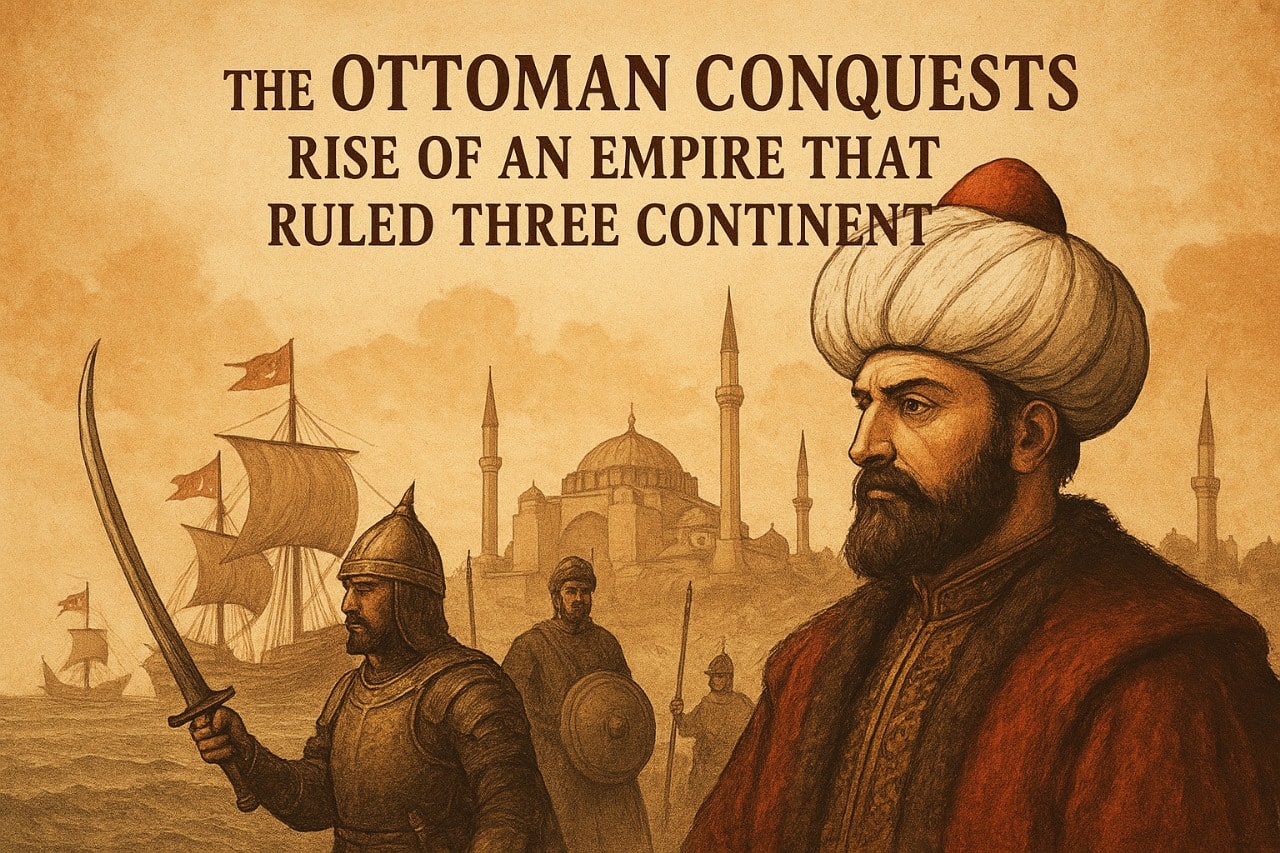
Introduction: The Dawn of a Global Empire
The story of the Ottoman Empire is one of the most remarkable chapters in world history. Emerging from the ashes of the fragmented Seljuk state in the late 13th century, a small Anatolian beylik (principality) under Osman I transformed into one of the mightiest empires the world has ever seen. Over the course of six centuries, the Ottoman Empire expanded across three continents Asia, Europe, and Africa influencing politics, culture, trade, religion, and architecture. Its rise was not a coincidence but the result of strategic warfare, visionary leadership, and a blend of military innovation with administrative genius.
Origins: From Osman to Empire
The roots of the Ottoman Empire trace back to around 1299, when Osman I, a Turkish tribal leader, declared independence from the declining Seljuk Sultanate of Rum. Osman’s followers were mostly ghazis warriors motivated by both faith and fortune. The early Ottomans capitalized on the political vacuum left by the weakening Byzantine Empire in Anatolia. With a combination of diplomacy and force, Osman and his successors began capturing border towns and strategic fortresses.
Osman’s successor, Orhan (r. 1326–1362), captured Bursa in 1326, marking a significant milestone. Bursa became the first capital of the Ottoman state and a thriving center for administration and trade. Orhan also established the first standing Ottoman army a move that laid the foundation for future military dominance. The Ottomans were no longer a loose tribal confederation; they were evolving into an organized empire.
The Fall of Constantinople: The Turning Point of 1453
No event symbolizes Ottoman ascendancy more powerfully than the fall of Constantinople in 1453. Sultan Mehmed II, later known as Mehmed the Conqueror, was only 21 years old when he achieved what countless Muslim and Christian armies had failed to do for centuries. Constantinople, the capital of the Byzantine Empire, was the greatest city of its time rich, fortified, and strategically vital.
Mehmed II’s campaign was a masterpiece of planning and technology. He deployed enormous cannons, including the legendary “Basilica,” capable of smashing the city’s ancient walls. The siege lasted 53 days, and on May 29, 1453, the Ottomans breached the defenses and entered the city. The conquest of Constantinople marked the end of the Byzantine Empire and the birth of Istanbul as the capital of a new Islamic superpower.
The city became a symbol of unity between East and West a bridge of civilizations. Under Ottoman rule, Istanbul blossomed with mosques, markets, and madrasas, and became one of the most cosmopolitan cities on earth.
Expansion into Europe: The Conquest of the Balkans
Following the fall of Constantinople, the Ottomans turned their attention westward. The Balkan Peninsula became the next stage of their expansion. Over the 14th and 15th centuries, Ottoman armies, led by disciplined Janissaries, swept through southeastern Europe. Serbia, Bulgaria, Albania, and Greece gradually fell under Ottoman rule.
The Battle of Kosovo (1389) and Battle of Nicopolis (1396) were decisive moments that demonstrated the Ottoman military’s superiority over European crusader forces. Later, the Battle of Varna (1444) sealed Ottoman dominance in the region.
Ottoman rule in the Balkans wasn’t merely about conquest. The empire introduced a sophisticated administrative system based on tolerance and pragmatism. Christians and Jews were allowed to practice their faiths under the millet system, which gave religious communities a degree of autonomy. This pragmatic approach helped maintain stability in a diverse and multiethnic empire.
The Age of Süleyman the Magnificent: The Zenith of Power
The 16th century was the golden age of the Ottoman Empire, symbolized by the reign of Sultan Süleyman the Magnificent (r. 1520–1566). His era represented the peak of Ottoman territorial expansion, cultural achievement, and legal reform.
Süleyman’s armies advanced deep into Europe, capturing Belgrade (1521) and most famously besieging Vienna in 1529. Although the siege failed, it demonstrated the empire’s reach into the heart of Europe. In the east, Süleyman waged successful campaigns against the Safavids in Persia, securing control over Mesopotamia (modern-day Iraq). In North Africa, Ottoman fleets dominated the Mediterranean under legendary admirals like Hayreddin Barbarossa, who made the empire a naval powerhouse.
Under Süleyman, the empire’s territory stretched from the gates of Vienna to Yemen, from Algeria to the Persian Gulf. His reign also saw legal and cultural flourishing. Known as Kanuni (the Lawgiver), Süleyman codified a unified system of laws that blended Islamic Sharia with administrative regulations, ensuring justice across his vast domains.
Military Power and the Janissary Corps
The success of the Ottoman conquests was deeply tied to their military innovations. The Janissary Corps, established in the 14th century, became one of the most disciplined and formidable military forces in the world. Recruited through the devshirme system a levy of Christian boys converted to Islam and trained in loyalty to the Sultan the Janissaries were elite infantry who formed the backbone of Ottoman might.
The Ottomans were also pioneers in the use of gunpowder weaponry. Cannons, muskets, and artillery units played decisive roles in battles from Constantinople to Hungary. Their combination of mobility, firepower, and organization gave them an unmatched edge against both European and Asian adversaries.
The Naval Dominance: Masters of the Seas
While the Ottoman armies conquered lands, their navy ruled the waves. The Ottoman fleet dominated the Mediterranean, Red Sea, and parts of the Indian Ocean. Under the command of admirals like Barbarossa and Piri Reis, the empire extended its influence over North Africa, Arabia, and even parts of the Indian subcontinent.
In 1571, however, the Battle of Lepanto marked a major naval defeat against the combined Christian forces of Europe. Despite this setback, the Ottomans rebuilt their fleet within a year, demonstrating the empire’s resilience and resources.
The Cultural and Architectural Flourishing
The Ottoman conquests were not merely military campaigns they were accompanied by a cultural renaissance. Istanbul, Edirne, and Bursa became centers of Islamic art, architecture, and scholarship.
The empire’s architectural legacy remains one of its most enduring symbols. Grand mosques such as Süleymaniye Mosque, Blue Mosque, and Selimiye Mosque stand as testaments to the Ottomans’ architectural brilliance, blending Byzantine elements with Islamic aesthetics.
Artists, calligraphers, and poets flourished under imperial patronage. The Ottomans encouraged intellectual exchange, attracting scholars from Persia, Arabia, and Europe. The result was a vibrant fusion of Eastern and Western traditions an empire that celebrated diversity under a single banner.
Governance and the Millet System: The Secret of Stability
One of the keys to the Ottoman Empire’s longevity was its administrative genius. The empire ruled over a vast population of Turks, Arabs, Greeks, Armenians, Kurds, Jews, and Slavs all with different faiths, languages, and customs.
The millet system provided a framework for religious coexistence. Each community (Muslim, Orthodox Christian, Armenian, Jewish) had its own religious leaders, courts, and schools, operating semi-autonomously under Ottoman oversight.
This system allowed the empire to maintain social harmony while collecting taxes efficiently and ensuring loyalty to the Sultan. It was an early model of multicultural governance that stood in contrast to the religious intolerance seen elsewhere in medieval Europe.
Challenges and Decline: The Long Retreat
Every empire has its rise and fall. By the 17th century, signs of stagnation began to appear. The failed Second Siege of Vienna (1683) marked a turning point. European powers, now technologically and economically more advanced, began to push the Ottomans back.
Internal corruption, military complacency, and economic difficulties eroded the empire’s power. The once-elite Janissaries became a political liability, resisting reform and modernization. The Treaty of Karlowitz (1699) forced the Ottomans to cede large territories in Europe for the first time.
Over the next two centuries, nationalist uprisings, European colonial expansion, and internal decay gradually dismantled Ottoman control. Despite attempts at modernization under the Tanzimat reforms (1839–1876), the empire could not match the industrial and military might of Europe.
By the end of World War I (1914–1918), the “Sick Man of Europe,” as Western powers called it, collapsed entirely. The Treaty of Sèvres (1920) dissolved the empire, paving the way for the birth of the modern Republic of Turkey in 1923 under Mustafa Kemal Atatürk.
Legacy of the Ottoman Conquests
The Ottoman Empire’s influence did not vanish with its fall. Its legacy continues to shape the modern world in profound ways. From architecture and cuisine to law and language, traces of Ottoman culture remain deeply woven into the fabric of the Middle East, Balkans, and North Africa.
The empire’s administrative systems influenced modern governance models in several countries. Its architectural masterpieces attract millions of tourists each year. The Ottoman tradition of coexistence though imperfect offers historical lessons on managing diversity in a globalized world.
Moreover, the Ottoman conquests bridged the gap between medieval and modern eras. The empire’s control over key trade routes connected Asia, Africa, and Europe, facilitating cultural and economic exchange that shaped global history.
1. The Strategic Geography of Ottoman Expansion
The Ottomans’ geographical position played a crucial role in their meteoric rise. Situated between Europe and Asia, the Anatolian peninsula was a natural crossroads for trade, culture, and conquest. By controlling the Bosporus and Dardanelles straits, the Ottomans gained the ability to dominate both sea and land routes. This strategic advantage not only strengthened their economy but also allowed them to launch campaigns into Europe and the Middle East with relative ease. Istanbul, their capital, became a hub where East met West a melting pot of civilizations.
2. The Role of Islam in Unifying the Empire
Religion served as both a unifying and legitimizing force for the Ottoman rulers. The Sultans considered themselves protectors of Islam, and after the conquest of Mamluk Egypt in 1517, they claimed the title of Caliph, the spiritual leader of the Muslim world. Islamic law (Sharia) became a central pillar of governance, but the Ottomans practiced a flexible and tolerant approach, accommodating diverse religious groups under their rule. This religious inclusivity was instrumental in maintaining peace across vast and varied territories.
3. The Ottoman Bureaucracy: A Machine of Efficiency
The Ottoman administration was a marvel of organization for its time. The empire’s vast bureaucracy ensured that taxes were collected, justice was served, and trade thrived. The Divan, or imperial council, managed everything from military campaigns to provincial governance. At the top stood the Grand Vizier a powerful figure who often acted as the Sultan’s chief executive. This bureaucratic structure allowed the empire to sustain itself for centuries, even during periods of weak leadership.
4. The Devshirme System: Foundation of Loyalty
One of the most fascinating and controversial aspects of the Ottoman system was devshirme, or the “blood tax.” Christian boys from the Balkans were taken, converted to Islam, and trained for service in the Janissary corps or in high administrative positions. While harsh by modern standards, the system created a class of highly loyal and capable officials who owed their status entirely to the Sultan. Many of the empire’s most influential statesmen, generals, and scholars emerged from this system.
5. Ottoman Diplomacy: Balancing Empires
The Ottomans were not only warriors but also master diplomats. They navigated complex alliances and rivalries with European powers, particularly with France, Venice, and the Habsburgs. The Franco-Ottoman Alliance (1536) was a groundbreaking partnership between a Muslim empire and a Christian kingdom an early example of realpolitik diplomacy that shocked contemporary Europe. This ability to form pragmatic alliances ensured Ottoman survival and influence even as the political landscape of Europe shifted dramatically.
6. Trade and Wealth: The Economic Arteries of Power
Economic prosperity was the lifeblood of the Ottoman conquests. The empire’s control of key trade routes from the Silk Road to the Mediterranean made it a global economic superpower. Istanbul’s bustling markets were filled with spices from India, silk from China, and coffee from Arabia. The empire’s ports, like Alexandria and Smyrna, became major trade hubs. Revenue from customs, agriculture, and trade financed the military machine and the construction of monumental architecture.
7. The Role of Women in the Ottoman Court
Contrary to many assumptions, women held significant power in the Ottoman royal court. The Harem was not merely a private residence but a political institution. Influential women, such as Hürrem Sultan (Roxelana), wife of Süleyman the Magnificent, shaped imperial policies and court politics. The period known as the “Sultanate of Women” in the 16th and 17th centuries saw royal mothers and wives exercising real political influence, acting as regents and advisors to the Sultans.
8. The Golden Age of Ottoman Architecture
Ottoman architecture reached its zenith under the genius of Mimar Sinan, the empire’s chief architect during Süleyman’s reign. His masterpieces, such as the Süleymaniye Mosque in Istanbul and the Selimiye Mosque in Edirne, combined engineering precision with spiritual grandeur. These structures symbolized both imperial power and divine devotion. The use of domes, minarets, and geometric designs influenced Islamic architecture across the world.
9. The Ottoman Legal System: Balancing Sharia and Custom
The Ottomans developed a dual legal system combining Islamic law (Sharia) with Kanun, or secular administrative law. This balance allowed them to govern both Muslims and non-Muslims effectively. The legal reforms under Süleyman include the Magnificent standardized taxation, trade regulations, and property laws. The emphasis on justice and fairness enhanced the Sultan’s reputation as a protector of his subjects, earning him respect even among non-Muslim populations.
10. Education and Knowledge in the Ottoman World
The Ottomans placed great importance on education. Madrasas (Islamic schools) and libraries flourished in cities like Istanbul, Damascus, and Cairo. Scholars studied theology, philosophy, astronomy, and medicine. Ottoman cartographers such as Piri Reis produced world maps that astonished Europe for their accuracy. Science and learning were seen as extensions of faith, blending traditional Islamic scholarship with global knowledge.
11. Art, Music, and Calligraphy: The Soul of an Empire
The Ottoman court patronized artists, poets, and musicians, leading to a vibrant cultural scene. Miniature painting, intricate calligraphy, and fine textiles became hallmarks of Ottoman artistry. The art form known as Ebru (marbling) decorated manuscripts and official documents. Music blended Persian, Arab, and Byzantine influences, giving rise to unique compositions that reflected the empire’s diversity.
12. The Ottoman Postal and Intelligence Systems
To manage such a vast empire, communication was key. The Ottomans developed a sophisticated postal and intelligence network. Couriers on horseback carried official correspondence across continents, while spies and informants provided critical information on both internal and foreign affairs. This system ensured rapid response to rebellions, invasions, or diplomatic threats a vital element in sustaining imperial control.
13. The Integration of Conquered Peoples
Unlike many empires that imposed uniformity, the Ottomans embraced diversity. Newly conquered peoples were allowed to maintain their customs, languages, and religions in exchange for loyalty and taxes. This policy reduced resistance and fostered a sense of inclusion. The empire’s flexible governance turned former enemies into loyal subjects, allowing it to endure for centuries without widespread rebellion.
14. The Role of Technology and Gunpowder
The Ottoman military success was deeply linked to their early adoption of gunpowder technology. They were among the first to use cannons and muskets effectively in large-scale warfare. The legendary cannons of Constantinople revolutionized siege tactics, while mobile field artillery gave Ottoman armies a decisive edge over traditional cavalry-based European forces. This innovation marked the beginning of modern warfare.
15. The Cultural Exchange Between East and West
The Ottoman Empire acted as a bridge between Eastern and Western civilizations. Through trade, diplomacy, and conquest, it facilitated the flow of ideas, goods, and technologies. Coffee from Yemen spread to Europe through Ottoman ports, while European art and fashion influenced Ottoman elites. This cultural exchange shaped Renaissance Europe as much as it did Islamic civilization, proving that the Ottoman world was a global connector.
16. Religious Harmony and Tolerance
Despite being an Islamic empire, the Ottomans displayed remarkable tolerance for other religions. Christians, Jews, and other minorities thrived under Ottoman rule, often enjoying more rights than they did in contemporary Europe. The Jewish community, expelled from Spain in 1492, found refuge in Ottoman lands, particularly in Salonika and Istanbul. This tolerance fostered economic productivity and intellectual growth, enriching the empire’s social fabric.
17. The Role of the Janissaries in Politics
While the Janissaries were the empire’s elite military force, they eventually became a political faction. Over time, they gained privileges, wealth, and influence, often interfering in the succession of Sultans. Their growing power led to corruption and resistance to modernization. By the 19th century, Sultan Mahmud II recognized that reform was impossible without their elimination, leading to the Auspicious Incident (1826), where the Janissary corps was violently disbanded.
18. Ottoman Influence in the Arab World
After conquering the Mamluk Sultanate, the Ottomans incorporated much of the Arab world into their empire including Egypt, Syria, and the holy cities of Mecca and Medina. The Sultans’ role as Custodians of the Two Holy Mosques enhanced their legitimacy across the Muslim world. Ottoman architectural styles, legal systems, and administrative practices deeply influenced Arab societies, traces of which remain visible to this day.
19. The Decline of the Ottoman Economy
As European powers discovered new sea routes to Asia, the Ottoman economy suffered. The empire’s control over traditional land-based trade routes weakened. Meanwhile, corruption, heavy taxation, and military expenses drained the treasury. European industrialization left the Ottomans behind technologically and economically, contributing to their long decline during the 18th and 19th centuries.
20. The Enduring Legacy of Ottoman Civilization
Even after its fall, the Ottoman Empire’s legacy remains alive. Its architectural wonders, culinary traditions, music, and administrative ideas still shape many countries today. From the domes of Istanbul to the languages of the Balkans, Ottoman influence endures. The empire stands as a reminder that power, when combined with cultural vision and tolerance, can create civilizations that transcend time.
Conclusion: The Empire That Redefined Civilization
The rise of the Ottoman Empire was more than a tale of military conquest; it was the story of vision, endurance, and transformation. From a small Anatolian frontier state, it grew into a global power that ruled for over six centuries, shaping the course of history across three continents.
The Ottomans combined faith with pragmatism, warfare with diplomacy, and tradition with innovation. They left behind cities that still stand in glory, institutions that inspired nations, and a cultural legacy that continues to influence art, law, and politics.
The story of the Ottoman conquests is ultimately the story of human ambition of how determination, unity, and adaptability can turn a small tribe into a civilization that once ruled the known world.