
Introduction
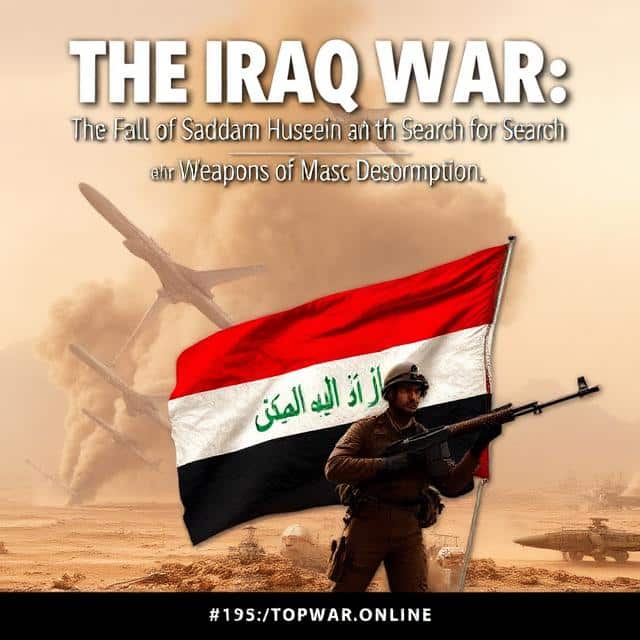
The Iraq War was one of the most controversial and consequential conflicts of the 21st century. Launched in 2003 by the United States and its allies, the war aimed to overthrow Saddam Hussein’s regime and eliminate Iraq’s alleged weapons of mass destruction (WMDs). What followed was a prolonged occupation, a bloody insurgency, and a transformation of Middle Eastern geopolitics. The Iraq War not only changed Iraq forever but also reshaped global debates about intervention, intelligence, and the use of force.
Background: Saddam Hussein’s Iraq
Saddam Hussein rose to power in Iraq in 1979 as a leading member of the Ba’ath Party. His rule was characterized by authoritarian control, brutal repression, and frequent wars. Saddam built one of the most powerful militaries in the Arab world and sought to dominate the Persian Gulf region.
In 1980, Saddam invaded neighboring Iran, sparking an eight-year conflict that killed over a million people. The Iran-Iraq War ended in 1988 without a clear victory, leaving Iraq heavily indebted and economically strained. Two years later, Saddam invaded Kuwait, triggering the Gulf War of 1991.
After his defeat in that war, Saddam faced severe international sanctions and United Nations inspections aimed at dismantling Iraq’s chemical, biological, and nuclear weapons programs. Despite these measures, Saddam remained in power, continuing to suppress dissent and defy UN resolutions.
By the late 1990s and early 2000s, tensions between Iraq and the United States were escalating once again. Washington accused Baghdad of concealing weapons of mass destruction and violating human rights.
The Road to War
Following the September 11, 2001 terrorist attacks on the United States, the George W. Bush administration began re-evaluating global security threats. Although Iraq had no direct link to the 9/11 attacks, U.S. officials argued that Saddam’s regime could provide WMDs to terrorist groups like al-Qaeda in the future.
Throughout 2002, the U.S. and the United Kingdom claimed that Iraq was continuing to develop weapons of mass destruction in secret. British Prime Minister Tony Blair supported President Bush in pushing for military action. In October 2002, the U.S. Congress authorized the use of force against Iraq.
The United Nations, however, remained divided. Many countries, including France, Germany, and Russia, called for more time for weapons inspections led by UNMOVIC (United Nations Monitoring, Verification and Inspection Commission). Chief inspector Hans Blix and his team did not find conclusive evidence of active WMD programs but noted that Iraq had not fully cooperated.
Despite the lack of a new UN mandate, the United States and its coalition partners decided to invade Iraq in March 2003.
The Invasion of Iraq (March–April 2003)
On March 20, 2003, the U.S.-led coalition launched Operation Iraqi Freedom. The invasion began with a massive aerial campaign known as “shock and awe,” designed to destroy Iraq’s command and control systems and demoralize its military.
Within days, U.S. and British troops advanced from Kuwait into southern Iraq. Major battles took place in cities such as Basra, Nasiriyah, and Karbala. Despite pockets of resistance, Iraqi forces collapsed rapidly. Baghdad fell on April 9, 2003, and a statue of Saddam Hussein was famously pulled down in Firdos Square, symbolizing the end of his regime.
On May 1, 2003, President Bush declared the end of major combat operations with the now-infamous “Mission Accomplished” speech aboard the USS Abraham Lincoln. However, the conflict was far from over.
The Fall of Saddam Hussein
After the invasion, Saddam Hussein went into hiding. U.S. forces launched an extensive manhunt, eventually capturing him on December 13, 2003, near his hometown of Tikrit. He was found hiding in a small underground bunker, armed but offering no resistance.
Saddam’s capture marked a major symbolic victory for the coalition. He was put on trial by the Iraqi Special Tribunal for crimes against humanity, including the mass killing of Kurds and Shiites. In 2006, Saddam Hussein was convicted and executed by hanging. His death, however, did not bring peace or unity to Iraq. Instead, it deepened sectarian tensions and opened a new phase of violence.
The Search for Weapons of Mass Destruction
The central justification for the Iraq War was the claim that Saddam Hussein possessed weapons of mass destruction. Coalition forces launched extensive searches across the country immediately after the invasion.
By 2004, the Iraq Survey Group, led by Charles Duelfer, released a comprehensive report concluding that Iraq had no active WMD stockpiles at the time of the invasion. While Saddam had maintained the knowledge and intention to restart his weapons programs eventually, no actual weapons were found.
This revelation caused a massive global backlash. Critics accused the Bush and Blair governments of manipulating or exaggerating intelligence to justify the war. The controversy damaged public trust and strained alliances among Western nations. The absence of WMDs became one of the defining issues of the Iraq War and a major lesson in intelligence and policy failure.
The Coalition Provisional Authority and the Occupation of Iraq
After the fall of Baghdad, the United States established the Coalition Provisional Authority (CPA) to govern Iraq temporarily. Headed by Paul Bremer, the CPA made several critical decisions that shaped Iraq’s future.
One of the most controversial moves was the policy of de-Ba’athification, which banned former Ba’ath Party members from government positions. Since most of Iraq’s experienced administrators and military officers were Ba’athists by necessity, this policy effectively dismantled the state apparatus.
Another major decision was disbanding the Iraqi Army. Hundreds of thousands of soldiers were left unemployed and angry, many of whom later joined insurgent or sectarian groups. These policies created a power vacuum and contributed directly to the rise of insurgency.
The Rise of the Insurgency (2004–2007)
By late 2003, Iraq descended into chaos. Various insurgent groups began attacking coalition troops, government facilities, and civilians. These groups included Sunni nationalists, former Ba’athists, and Islamic militants.
One of the most notorious insurgent leaders was Abu Musab al-Zarqawi, who founded al-Qaeda in Iraq (AQI). His organization carried out bombings, kidnappings, and brutal executions, aiming to provoke sectarian conflict between Sunni and Shia Muslims.
The insurgency transformed Iraq into a battlefield of car bombings, ambushes, and urban warfare. The cities of Fallujah, Mosul, and Ramadi became epicenters of resistance. The U.S. military faced a new kind of war: counterinsurgency in a highly volatile and divided society.
The Iraqi Civil War and Sectarian Violence
After Saddam’s fall, long-suppressed sectarian tensions between Sunni and Shia Muslims erupted into violence. The bombing of the al-Askari Mosque in Samarra in 2006 triggered waves of retaliatory attacks. Shia militias, such as the Mahdi Army led by Muqtada al-Sadr, clashed with Sunni insurgents across the country.
Neighborhoods in Baghdad became divided along sectarian lines. Ethnic cleansing, assassinations, and bombings became daily occurrences. The conflict evolved into a civil war that killed tens of thousands of Iraqis and displaced millions.
The U.S. Troop Surge and Temporary Stability (2007–2011)
In response to the worsening crisis, President Bush announced a new strategy in 2007 known as the “surge.” Approximately 30,000 additional U.S. troops were deployed to secure Baghdad and other key areas. This surge, combined with alliances with Sunni tribal leaders known as the “Awakening Councils,” helped to significantly reduce violence by 2008.
The surge created space for political reconciliation and rebuilding, but the progress was fragile. The underlying sectarian divides remained unresolved, and corruption within the Iraqi government continued.
In 2011, the United States officially withdrew its combat forces from Iraq, fulfilling an agreement signed with the Iraqi government under President Obama. The war was declared over, but instability soon returned.
The Rise of ISIS and the Aftermath of Withdrawal (2011–2017)
The power vacuum left by the U.S. withdrawal, combined with political corruption and sectarian discrimination, allowed extremist groups to reemerge. The remnants of al-Qaeda in Iraq regrouped under a new name: the Islamic State of Iraq and Syria (ISIS).
By 2014, ISIS captured vast territories in Iraq and Syria, including Iraq’s second-largest city, Mosul. The group declared a so-called “Caliphate” and imposed a reign of terror marked by executions, enslavement, and destruction.
The Iraqi government, supported once again by U.S. airpower and international forces, launched a campaign to defeat ISIS. After years of brutal fighting, ISIS was militarily defeated in Iraq by 2017. However, the war left behind deep wounds and ongoing instability.
Human and Economic Costs
The Iraq War exacted a heavy toll. Estimates suggest that between 200,000 and 400,000 Iraqis were killed, including combatants and civilians. Millions were displaced, creating one of the largest refugee crises in modern times.
Over 4,500 U.S. troops and hundreds of coalition soldiers lost their lives. The financial cost for the United States alone exceeded two trillion dollars when including long-term care for veterans.
Iraq’s economy and infrastructure suffered immense damage. Power shortages, unemployment, and poverty remained widespread even years after the fighting ended. The war also triggered lasting psychological trauma among Iraqis and veterans alike.
Global and Political Consequences
The Iraq War reshaped international relations and global perceptions of American power. It deepened skepticism about U.S. intelligence, eroded trust in Western leadership, and weakened support for future interventions.
The conflict also altered the balance of power in the Middle East. With Saddam gone, Iran expanded its influence across Iraq, supporting Shia militias and political parties. This shift created new regional rivalries that continue to affect the region’s stability.
Domestically, the war divided American politics, influencing presidential elections and shaping foreign policy debates for decades. The memory of the Iraq War continues to influence U.S. decisions about intervention in places like Syria, Libya, and Ukraine.
Lessons from the Iraq War
- Intelligence Must Be Verified – The failure to find WMDs highlighted the dangers of acting on unverified or politically influenced intelligence.
- Regime Change Does Not Guarantee Stability – Removing a dictator is far easier than rebuilding a nation’s institutions.
- The Dangers of Sectarian Politics – Ignoring ethnic and religious divisions can transform a liberation war into a civil war.
- Long-Term Commitment Is Essential – Rapid withdrawal without stability plans can lead to the resurgence of extremism.
- The Human Cost of War – Beyond strategy and politics, the lives lost and the suffering endured remind the world of war’s lasting impact.
Conclusion
The Iraq War stands as one of the defining events of the early 21st century. It began with promises of liberation and security but ended with questions about credibility, responsibility, and the limits of military power. Saddam Hussein’s fall ended decades of dictatorship, yet the chaos that followed reshaped Iraq and the entire Middle East.
The search for weapons of mass destruction became a cautionary tale about intelligence, propaganda, and the rush to war. For Iraqis, the conflict brought immense suffering but also moments of resilience and hope.
As historians and policymakers continue to analyze its legacy, the Iraq War remains a powerful reminder that every war carries unintended consequences and that the quest for peace must always be grounded in truth, humanity, and justice.