
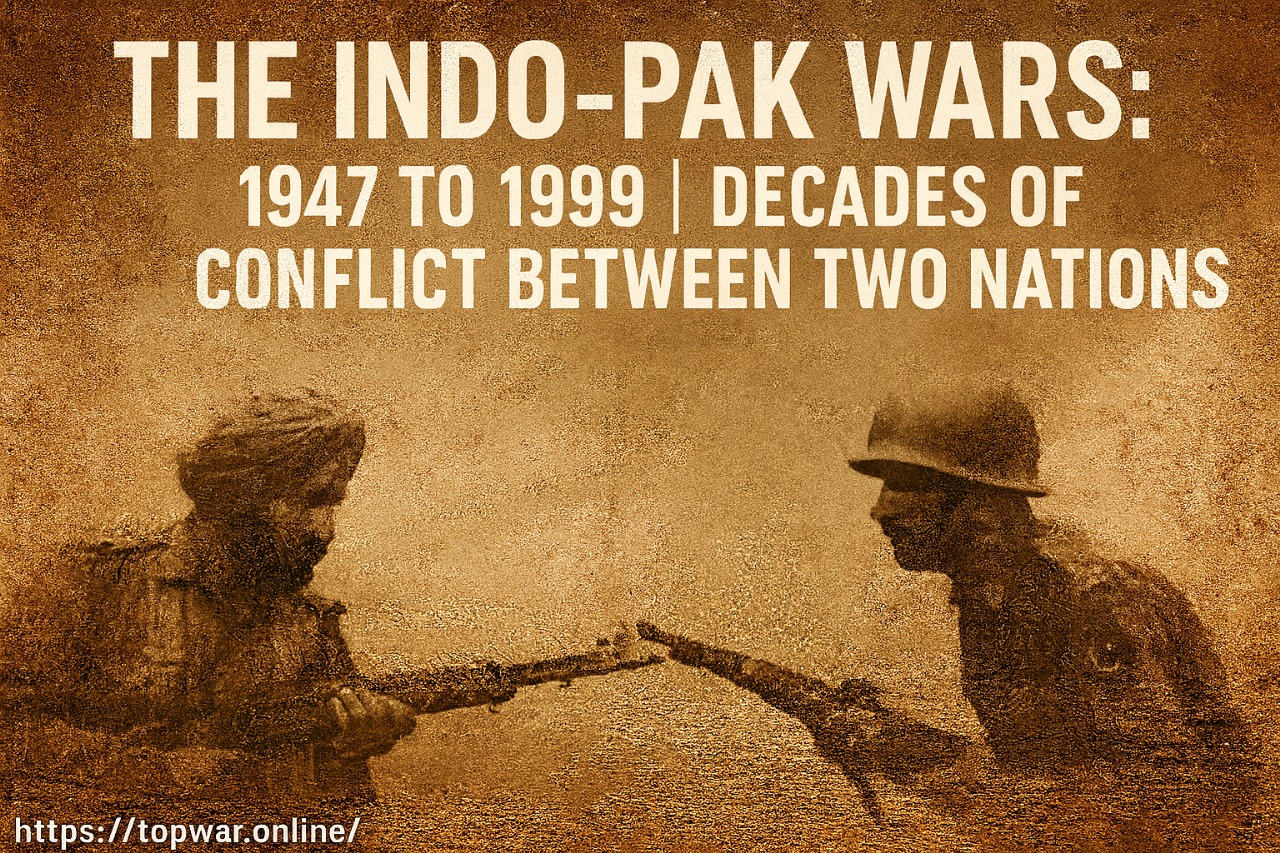
The history of India and Pakistan is deeply intertwined, with both countries sharing a long and complex relationship that has been shaped by territorial disputes, political tensions, and wars. Since the partition of British India in 1947, the two nations have been engaged in several conflicts, primarily centered around the region of Kashmir, which both countries claim in its entirety. Over the decades, these disputes have led to multiple wars, military skirmishes, and a continuing cycle of hostility and negotiation.
In this article, we will explore the key Indo-Pak wars from 1947 to 1999, examining the causes, events, and outcomes of each conflict. From the first Kashmir war in 1947 to the Kargil conflict in 1999, these wars have shaped the geopolitical landscape of South Asia and continue to influence the relationship between India and Pakistan today.
The First Kashmir War (1947-1948): The Beginning of a Long-Standing Conflict
The first Indo-Pak war began shortly after the partition of British India in 1947, when the princely state of Jammu and Kashmir became a key point of contention between India and Pakistan. At the time of partition, Jammu and Kashmir, under the rule of Maharaja Hari Singh, was predominantly Muslim, which made it a valuable territory for Pakistan. However, the Maharaja chose to accede to India, sparking outrage in Pakistan.
The Invasion and Indian Response
In October 1947, tribal forces from Pakistan, backed by the Pakistani military, invaded Kashmir, aiming to take control of the region. In response, India sent military forces to defend Kashmir. The conflict quickly escalated, and by December 1947, India had intervened with its military. The war was characterized by difficult terrain, harsh winters, and poorly equipped forces on both sides.
The UN Ceasefire and Division of Kashmir
In January 1949, a ceasefire brokered by the United Nations came into effect, establishing the Line of Control (LoC) and dividing the region into Indian-administered and Pakistan-administered territories. The Kashmir dispute remained unresolved, and both countries continued to claim the region in its entirety, setting the stage for future conflicts.
The Second Kashmir War (1965): A Full-Scale Conflict
Despite the ceasefire and the division of Kashmir, tensions between India and Pakistan did not subside. By the early 1960s, both nations had continued to build their military capabilities, and a second war broke out in 1965. This conflict, often referred to as the Second Kashmir War, was primarily fought over control of Kashmir, with both nations engaging in full-scale military operations.
Prelude to the War: Skirmishes and Escalation
In 1965, clashes erupted along the LoC as both India and Pakistan began probing each other’s defenses. The initial skirmishes escalated when Pakistan launched Operation Gibraltar, aimed at infiltrating forces into Indian-administered Kashmir and inciting insurgencies. India responded by launching Operation Grand Slam, which led to a full-scale war between the two countries.
The War and Its Outcome
The war saw heavy fighting, with both nations deploying large numbers of soldiers, tanks, and aircraft. The battlefields stretched across Kashmir and into the Punjab region. Although the conflict resulted in significant casualties on both sides, it ended in a stalemate, with neither country gaining a decisive victory.
In September 1965, a ceasefire was brokered by the United Nations, and both countries agreed to return to the pre-war positions. The war did not result in any significant territorial changes, but it further solidified the animosity between India and Pakistan and led to the realization that a diplomatic solution to the Kashmir issue was necessary.
The 1971 War: Bangladesh Liberation and a Decisive Victory for India
The third Indo-Pak war occurred in December 1971 and was markedly different from the previous conflicts. This war was triggered by the ongoing civil war in East Pakistan (now Bangladesh), where the population was fighting for independence from West Pakistan. India’s involvement in the conflict led to a full-scale war with Pakistan, and the outcome of this war had a lasting impact on the subcontinent.
The Roots of the Conflict: Bangladesh Liberation Movement
In March 1971, the Pakistani military launched Operation Searchlight in East Pakistan to suppress the growing independence movement. This led to widespread atrocities and millions of refugees fleeing to India. India, under Prime Minister Indira Gandhi, provided support to the East Pakistani independence movement, culminating in India’s military intervention in December 1971.
The War and Its Aftermath
The war lasted just two weeks but resulted in a decisive victory for India. The Indian military quickly overwhelmed Pakistani forces in East Pakistan, leading to the surrender of Pakistani troops in Dhaka on December 16, 1971. As a result of the war, East Pakistan gained independence and became the sovereign state of Bangladesh.
The 1971 war marked a significant turning point in the Indo-Pak relationship. Pakistan’s military was severely weakened, and India’s influence in the region grew substantially. The war also demonstrated the importance of international alliances, as India received support from the Soviet Union while Pakistan sought assistance from the United States.
The Kargil War (1999): A Conflict in the Mountains
The Kargil War of 1999 was the last major military conflict between India and Pakistan in the 20th century. The war was fought in the mountainous Kargil district of Jammu and Kashmir, an area strategically important for both countries. Unlike the previous wars, the Kargil conflict was not a full-scale war but rather a limited conflict that took place in a specific region.
The Infiltration and Escalation
In 1999, Pakistani forces and militants infiltrated the Kargil region, occupying strategic high-altitude positions along the Line of Control. India discovered the infiltration in May 1999 and launched Operation Vijay to reclaim the territory. The war was fought in difficult terrain at high altitudes, with both sides suffering heavy casualties.
International Diplomacy and the End of the Conflict
The Kargil War was notable for its international dimension. The United States and other countries strongly supported India, urging Pakistan to withdraw its forces. International pressure, coupled with India’s military success, led to a Pakistani retreat. By July 1999, India had regained control of the Kargil region.
While the Kargil War did not escalate into a larger conflict, it was a reminder of the persistent hostility between India and Pakistan and the volatility of the Kashmir issue. The war also highlighted the growing importance of nuclear weapons, as both countries had conducted nuclear tests in 1998, raising concerns about the potential for a nuclear conflict.
The Legacy of the Indo-Pak Wars: Continuing Tensions and the Path Forward
The wars between India and Pakistan have left a lasting impact on both countries and the region. The territorial dispute over Kashmir remains unresolved, and tensions between the two nations continue to simmer. Despite several peace efforts and attempts at dialogue, the relationship between India and Pakistan remains fragile, with periodic skirmishes and military standoffs along the LoC.
Nuclearization and the Risk of Conflict
Both India and Pakistan possess nuclear weapons, which has added a new dimension to the conflict. The prospect of nuclear war looms over the region, making diplomatic efforts even more crucial. While nuclear deterrence has prevented a full-scale war since the Kargil conflict, the risk of escalation remains a significant concern.
Moving Toward Peace?
While the Indo-Pak wars have left a legacy of distrust and division, there have been moments of hope for peace. In recent years, both countries have engaged in sporadic dialogue, and some confidence-building measures have been put in place. However, the Kashmir issue, along with other political and military tensions, continues to complicate any potential for lasting peace.
Conclusion: The Indo-Pak Wars – A Story of Conflict, Resilience, and Hope
The Indo-Pak wars, spanning over five decades, are a testament to the resilience of both nations and the enduring complexity of their relationship. From the first Kashmir war in 1947 to the Kargil conflict in 1999, these wars have shaped the destinies of both countries and defined their political, military, and diplomatic trajectories.
While the path to peace remains fraught with challenges, the hope for a peaceful resolution to the Kashmir dispute and improved relations between India and Pakistan continues to be a shared aspiration of many. The legacy of these wars serves as a reminder of the devastating consequences of conflict, as well as the importance of diplomacy, dialogue, and mutual understanding in resolving disputes.