
Introduction
In the early months of 1991, the world watched as one of the most rapid and decisive conventional military operations of the late 20th century unfolded. The Gulf War, which erupted when Kuwait was invaded by Saddam Hussein’s Iraq in August 1990, culminated in the launch of Operation Desert Storm on 17 January 1991. Military.com+3britannica.com+3britannica.com+3 This campaign was not only about liberating Kuwait – it also ushered in a new era of modern warfare: one dominated by precision weapons, air supremacy, networked forces, coalition logistics and media-live coverage. In this article we explore the origins, the coalition build-up, the air and ground campaigns, the technology, the aftermath and the broader implications for warfare in the post-Cold-War world.
Origins and Causes of the Conflict
The roots of the Gulf War lie in the aftermath of the 1980-88 Iran-Iraq War, Iraq’s massive debts, regional oil dynamics, and tensions over border and oil-field disputes. Military.com+1 Iraq accused Kuwait and the United Arab Emirates of over-producing oil, driving down prices and squeezing Iraq’s economy. Military.com On 2 August 1990, Iraqi forces invaded and annexed Kuwait, triggering condemnation by the United Nations and sweeping sanctions. britannica.com+1 The U.N. demanded withdrawal; Iraq refused; and the stage was set for a large-scale international military response. This crisis tested how the post-Cold-War world would respond to naked aggression and how modern militaries would deploy and operate.
Coalition Formation and Buildup: Desert Shield
In response to the Iraqi invasion of Kuwait, coalition forces amassed under what would become the lead-in to Operation Desert Storm. This phase was termed Operation Desert Shield. U.S. forces rapidly deployed to Saudi Arabia and the Gulf, joined by dozens of allied nations. Military.com+1 The logistical feat was immense: thousands of aircraft, tanks, troops and supplies moved into the theatre. According to historical accounts, the U.S. Army described the war as a pivotal moment in its post-Vietnam transformation. history.army.mil Morocco, Egypt, Saudi Arabia, the UK, France, the Soviet Union (in its waning days) and many others contributed, giving the coalition a broad legitimacy. Military.com The build-up phase also involved extensive planning, deception operations, and the deployment of advanced sensors, command-and-control, and intelligence systems — all hallmarks of what would become modern warfare.
The Air Campaign: Dominating the Skies
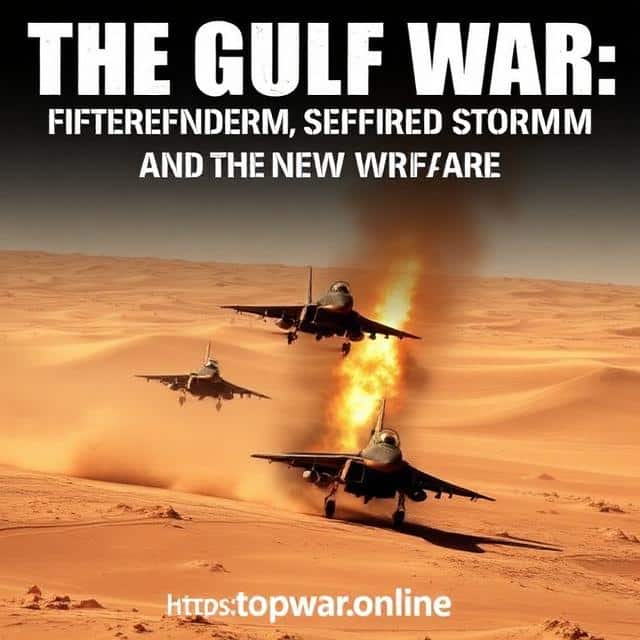
On 17 January 1991, the coalition commenced the air phase of Operation Desert Storm. britannica.com+2Imperial War Museums+2 The air offensive had three primary objectives: establish air supremacy, degrade and destroy Iraqi command, control, communications and logistics; and soften Iraqi ground forces for the impending land assault. britannica.com+1 Coalition aircraft flew tens of thousands of sorties, dropping vast tonnages of bombs, employing cruise missiles (such as the Tomahawk) and precision guided munitions. Military.com+1 One example: the Iraqi air-defence network was extensive — thousands of SAMs (surface-to-air missiles), anti‐aircraft guns, radars and protected shelters. Imperial War Museums+1 Yet the coalition overcame these with superior technology, tactics and integration. Within days the coalition achieved air superiority, enabling freedom of action for the ground forces. britannica.com+1
The Ground Offensive: Swift and Decisive
With the skies securely controlled, the coalition launched the ground offensive – known as Operation Desert Sabre – on 24 February 1991. britannica.com+1 What followed was a remarkably swift advance: Iraq’s forces, already degraded by weeks of air attacks and cut‐off logistics, crumbled. According to some accounts, the main ground phase lasted only about 100 hours. britannica.com Along what became known as the “Highway of Death”, retreating Iraqi convoys were heavily attacked, illustrating both the speed and ruthlessness of the coalition’s advance. noravox.com In many sectors Iraqi units surrendered en masse or fled; the coalition liberated Kuwait by the end of February. The combination of overwhelming firepower, mobility, coordination and logistics made this one of the most lopsided conventional wars in modern history.
Technological & Tactical Innovations: The New Age of Warfare
Operation Desert Storm stands out in military history not just for the outcome, but for how it changed the nature of warfare. Several innovations and tactical shifts are noteworthy:
Precision Weapons and Smart Munitions
The war saw widespread use of guided bombs, cruise missiles (such as Tomahawks) and stealth aircraft. According to Britannica, Desert Storm included the first coordinated Tomahawk/manned-aircraft strike in history. britannica.com These technologies increased accuracy, reduced exposure of pilots and ground forces, and allowed targets deep inside Iraq to be hit with pinpoint strikes.
Integrated Command and Control, Sensors & Real‐Time Intelligence
Coalition forces deployed satellite reconnaissance, real-time communications, GPS navigation, and vastly improved battlefield awareness. The Iraqi command‐and‐control system, by contrast, proved rigid and outdated. USMC University The ability to synchronise air and ground operations, to move logistics rapidly and to exploit enemy weaknesses, became key.
Air Supremacy & Suppression of Enemy Air Defence (SEAD)
As mentioned earlier, gaining control of the air was essential. Once that was achieved, coalition aircraft could operate with relative impunity and provide close air support, reconnaissance and interdiction. The Iraqi air defence assets, though large in number, were overwhelmed by the technological edge and coordinated tactics of the coalition. Imperial War Museums+1
Rapid Mobility, Shock & Awe Principles
While the term “Shock and Awe” became more popular in later wars, the speed, surprise and overwhelming force used in Desert Storm foreshadowed those concepts. The ground campaign’s rapid success rested on manoeuvre, deception and striking at critical vulnerabilities — not just head-on attrition. Analysts note that this campaign “represented one of the largest and most impressive air campaigns of all time”. Imperial War Museums
Human and Material Costs
Despite its brevity, the Gulf War inflicted significant human, environmental and material costs.
Casualties
Coalition casualties were remarkably low compared to prior large-scale conventional wars: for example, just 147 U.S. personnel were killed in action during the air-ground campaign. britannica.com By contrast, estimates of Iraqi military deaths range from 8,000 to 50,000 — some sources even estimate higher when including wounded and missing. britannica.com+1 Civilian casualties and displacement were also substantial, though harder to quantify. Number Analytics
Environmental and Infrastructure Damage
As Iraqi forces retreated from Kuwait, they ignited more than 700 oil wells, releasing millions of barrels of oil into the desert and Persian Gulf, triggering major ecological damage. WorldAtlas+1 The region’s environment became a casualty: smoke, oil lakes, contamination of water and soil, and acid rain as far afield as southern Turkey. Imperial War Museums+1 The destruction of Iraqi infrastructure — power plants, manufacturing, oil refining, transport, command networks — incapacitated the country for years. britannica.com+1
Economic Cost
The financial cost to the U.S. was estimated at about US$61 billion, though much of that was repaid by Kuwait, Saudi Arabia and other allied states. WorldAtlas However, Iraq bore the greater economic burden — war damage, sanctions, loss of oil revenue, reconstruction and the long-term downward slide of its economy. Imperial War Museums+1
Political and Strategic Consequences
The Gulf War produced major geopolitical shifts and set the tone for the post-Cold-War era.
U.S. “Unipolar Moment” and Middle East Dominance
Some analysts regard Desert Storm as the moment when the U.S. emerged as the undisputed military superpower, the coalition victory signalling a new era of American military dominance. britannica.com+1 The war also reinforced U.S. presence in the Middle East – Saudi Arabia, Kuwait and other Gulf states remained under American security umbrellas for decades.
Regional Dynamics
Although Kuwait was liberated, Iraq’s regime under Saddam Hussein remained intact. He suppressed uprisings by Kurds in the north and Shiʿa in the south of Iraq, prompting the establishment of U.S./British no-fly zones over Iraqi airspace. britannica.com The sanctions regime placed on Iraq after the war lasted many years, inflicting heavy humanitarian consequences. britannica.com+1
The Precursor to Later Conflicts
The war served as a template — for both good and bad — for future military operations. The idea of rapid deployment, coalition operations, precision strikes and overwhelming air power influenced U.S. strategy in the 1990s and 2000s. Some commentators argue that Iraq’s later invasion in 2003 had its roots in the unresolved issues from 1991. britannica.com+1 The war also raised ethical, legal and media-based questions about modern warfare: how civilians are impacted, how media imagery shapes public perception, and what limits there are on the use of force.
Lessons Learned: Warfare in the Modern Age
Reflecting on Operation Desert Storm provides several key lessons for military strategists, historians and policy-makers.
The Primacy of Air Power and Logistics
Desert Storm demonstrated that air superiority and overwhelming logistics can decisively shape ground operations. Without control of the skies and without secure supply lines, the Iraqi army faced a rapid collapse. The importance of logistics has since become central to modern military planning. Reddit+1
The Impact of Technology on Casualty Rates and Warfare Tempo
The gulf between coalition and Iraqi technology was stark. Precision weapons, night vision, real-time communications all contributed to the low coalition casualties and the rapid tempo of operations. The war thus offered a glimpse of what “high-tech” war looks like. Reddit
Coalition Warfare and Multinational Coordination
The coalition’s success hinged in part on its multinational character and shared objectives. The Bringing together of Arab states with Western powers and former Cold-War adversaries under a U.N. mandate provided legitimacy and strength. Military.com
Strategic Clarity and Defined Objectives
In contrast to many later military engagements, Desert Storm had clearly defined goals — liberate Kuwait, destroy Iraqi capability to threaten its neighbours, uphold U.N. resolutions. The relative clarity of those objectives contributed to its success. Many conflicts since have lacked such clarity.
The Limits of Military Victory Without Political Resolution
Though the coalition achieved a stunning military victory, the political outcomes were less satisfactory. Saddam Hussein remained in power; Iraq suffered for years under sanctions; U.N. resolutions lingered; and the region’s deeper issues (ethnic tensions, authoritarian governance, regional rivalries) remained unresolved. This underscores the lesson that military force alone does not guarantee lasting peace.
Ethical, Media & Humanitarian Dimensions
Operation Desert Storm also must be viewed through the lens of ethics, media coverage and humanitarian impact.
Media Coverage: “Televised War”
This was among the first major wars to be broadcast live around the clock. News networks showed precision strikes, burning Kuwaiti oil wells, retreating Iraqi columns. Some scholars argue that the war’s imagery – like the Highway of Death – desensitized audiences to violence. WorldAtlas
Civilian Impact and Humanitarian Concerns
Although coalition casualties were low, Iraqi civilians suffered from the bombings, from deprivation under sanctions and from the environmental damage. The sanctions regime, in particular, was controversial—while it aimed to contain Iraq’s weapons of mass destruction capability, it also caused widespread suffering among ordinary Iraqis. Imperial War Museums+1
Environmental and Ecological Ethics
The deliberate burning of oil wells and the massive oil spills from Iraqi retreat caused long-term environmental harm. These raise ethical questions about warfare’s impact on the natural world and civilian-adjacent populations. Wikipedia+1
Legacy: How Desert Storm Shaped Future Wars
The impact of Desert Storm can still be felt today in military doctrine, geopolitics and warfare trends.
Doctrinal Shifts
Military planners increasingly emphasise “effects-based operations”, network-centric warfare, rapid deployability, and precision long-range strikes. The model of Desert Storm provided proof of concept.
Technology Proliferation
After Desert Storm the value of precision-guided munitions, stealth, GPS and real-time intelligence became accepted norms. Subsequent conflicts (Balkans, Afghanistan, Iraq) incorporated these lessons, though often with different political constraints.
Political and Strategic Precedents
The war reaffirmed U.N. security resolutions’ teeth (though not always their after-care). It reinforced U.S. commitment to Middle East security, something still evident in U.S. military posture and alliances today. The war’s outcome also influenced Iraq’s later trajectory and the decisions of regional powers.
Modern Warfare’s New Face
Desert Storm heralded what many call the “post-modern war” era: high technology, asymmetric risks, media-intensive conflict, and large power—but also low casualties for opponents with superior capabilities. It also showed that sheer size of a military (e.g., Iraq’s large armed forces) cannot compensate for outdated doctrine, poor training, weak logistics and lack of integrated command. Imperial War Museums+1
Conclusion
The Gulf War and Operation Desert Storm stand as a watershed moment in military history. From a rapid-build coalition through to a highly-efficient air campaign and a lightning ground offensive, the conflict crystallised the characteristics of modern conventional war: technology, precision, integration, logistics, and clear objectives. Yet the triumph was also tempered by long-term challenges: humanitarian fallout, regional instability, environmental damage, and the persistence of unresolved political conflicts. For bloggers, historians and military-strategy enthusiasts alike, the war offers rich lessons about the nature of force, the limits of victory, and the dynamics of power in a changing world. As you map out your 30 articles, this story serves as an ideal model of how warfare in the 1990s transformed into the kind of conflict we see in the 21st century.