

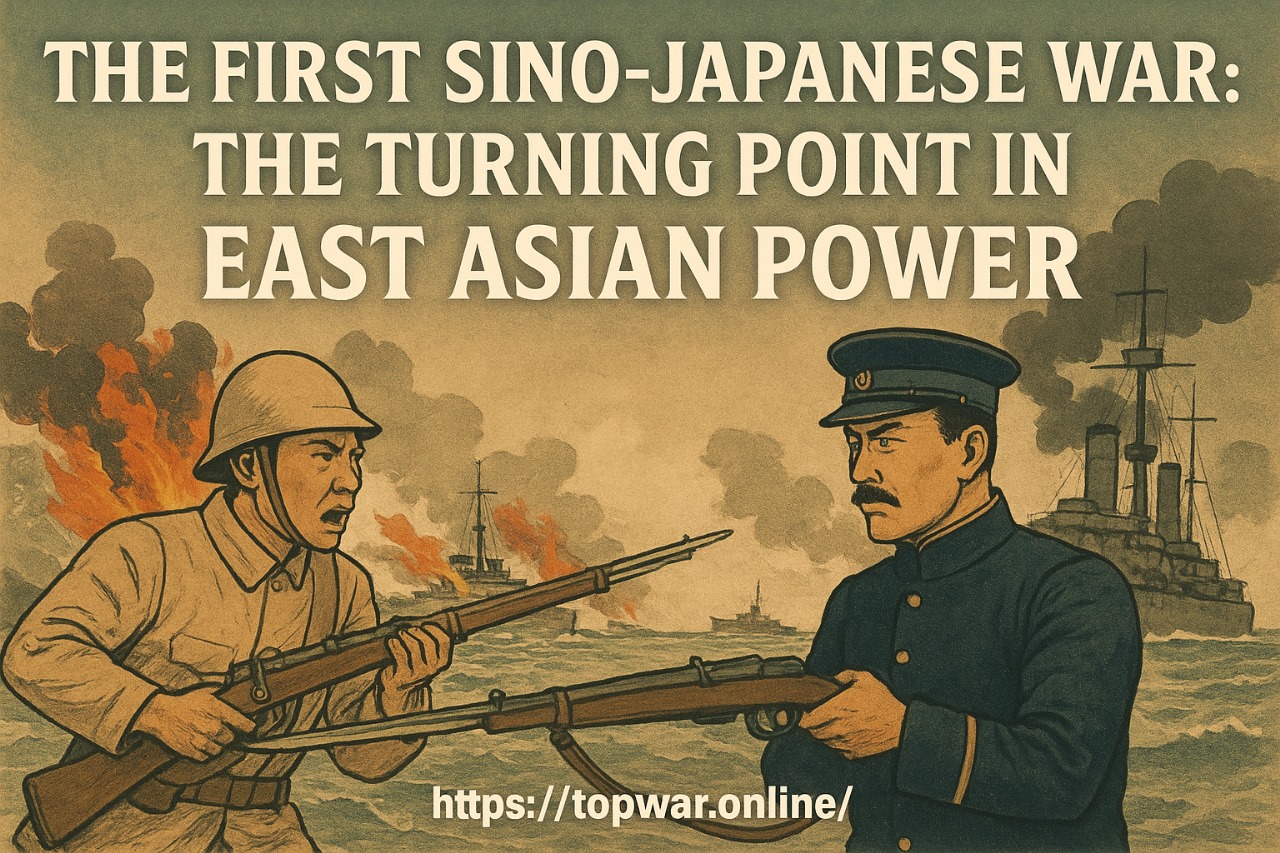
The First Sino-Japanese War (1894–1895) was a defining conflict in East Asian history. It marked the dramatic shift in the balance of power in the region, with Japan emerging as the dominant force in East Asia and China beginning its long decline as a global power. The war not only reshaped the political landscape of East Asia but also set the stage for the broader imperialistic struggles that would characterize the 20th century. In this article, we will explore the causes, key battles, and the lasting impact of the First Sino-Japanese War, highlighting its significance in the development of modern East Asia.
Background: The Decline of the Qing Dynasty and Japan’s Rise
By the late 19th century, China was in a period of severe decline. The Qing Dynasty, which had ruled China for over two centuries, was struggling with internal unrest, economic stagnation, and the increasing pressures from Western imperial powers. The Opium Wars (1839–1842, 1856–1860) had forced China to open its ports to foreign trade, and the subsequent Unequal Treaties had carved up China into foreign-controlled territories. The Taiping Rebellion (1850–1864), which led to the deaths of millions, and the Boxer Rebellion (1899–1901), which was a response to foreign intervention, further weakened the Qing government’s authority.
Meanwhile, Japan, once isolated from the rest of the world under the Tokugawa shogunate, had undergone a dramatic transformation following the Meiji Restoration in 1868. The new Meiji government embarked on rapid modernization, adopting Western technologies, industrializing the economy, and reforming the military. Within a few decades, Japan transformed from a feudal society into a modern industrial state, and it began to assert its influence in East Asia. By the 1890s, Japan had become an emerging imperial power, eager to expand its territory and assert itself as a regional leader.
The Spark: The Conflict Over Korea
At the heart of the First Sino-Japanese War was the fate of Korea. Korea had been a tributary state of China for centuries, and the Qing Dynasty had long held sway over the Korean Peninsula. However, in the 19th century, Korea became increasingly exposed to foreign influences, particularly from Japan and Western powers. Japan, having modernized rapidly, saw an opportunity to expand its influence in Korea, which had strategic and economic significance.
In 1894, a peasant uprising known as the Donghak Peasant Revolution broke out in Korea, threatening the ruling Joseon Dynasty. The Korean government requested Chinese assistance to suppress the rebellion. China, which had long viewed Korea as part of its sphere of influence, sent troops to restore order. Japan, however, saw this as an opportunity to assert its own dominance over Korea. The Japanese government demanded that China withdraw its forces, but when China refused, Japan decided to act.
Japan, which had modernized its military and developed a powerful navy, quickly mobilized its forces and declared war on China on July 25, 1894. Thus began the First Sino-Japanese War, a conflict that would reshape the power dynamics of East Asia.
The War: Battles, Strategy, and Turning Points
The First Sino-Japanese War was characterized by Japan’s superior military strategy, advanced technology, and effective leadership. Japan’s army and navy had undergone extensive reforms and modernization during the Meiji period, while China’s military was outdated, poorly organized, and burdened by internal corruption.
The Battle of Pungdo (July 25, 1894)
The war began with Japan’s naval victory at the Battle of Pungdo, where Japanese forces decisively defeated the Chinese navy. This early victory gave Japan control over the seas and marked the beginning of a series of successful naval and land engagements.
The Battle of the Yalu River (April 1895)
One of the most important battles of the war took place at the Yalu River, where Japan’s modernized fleet and naval tactics outmatched China’s larger, but less effective, navy. The Japanese fleet, under the command of Admiral Togo Heihachiro, delivered a crushing defeat to the Chinese forces, establishing Japan’s dominance over the waters around Korea and northern China.
The Fall of Port Arthur
Another key moment came with Japan’s successful siege of the Port Arthur fortress, a Chinese naval base on the Liaodong Peninsula. Port Arthur was an important strategic location, and its capture by Japanese forces marked a turning point in the war. Japan’s control of this naval base significantly weakened China’s ability to defend its coastal regions.
The Battle of Weihaiwei
In January 1895, Japan launched a final assault on the Chinese fleet at Weihaiwei, a port city in Shandong province. After a fierce battle, Japan completely destroyed the remaining Chinese navy, effectively crippling China’s maritime capabilities. By February 1895, Japan had secured victory in the war, with the Qing Dynasty forced to surrender.
The Treaty of Shimonoseki: The End of the War
On April 17, 1895, the war officially ended with the signing of the Treaty of Shimonoseki, which was highly unfavorable to China. The key provisions of the treaty were:
- Korea’s Independence: China was forced to recognize Korea’s independence, effectively ending its traditional control over the Korean Peninsula. This paved the way for Japan to dominate Korea in the years to come.
- Territorial Losses: China ceded Taiwan and the Pescadores Islands to Japan. These islands became important bases for Japanese expansion in East Asia.
- Monetary Indemnity: China had to pay a large indemnity of 200 million taels of silver to Japan, which placed further strain on China’s weakened economy.
- Liaodong Peninsula: China was forced to cede the Liaodong Peninsula and the port city of Dalian to Japan. This was a key strategic loss, as it gave Japan a foothold in Manchuria. However, Japan’s control over this territory was short-lived due to international pressure (mainly from Russia, Germany, and France), which led to Japan’s eventual withdrawal in exchange for further reparations.
The Treaty of Shimonoseki marked a humiliating defeat for China, and it signaled the rise of Japan as a new imperial power in East Asia.
The Aftermath: The Impact on China and Japan
China: The Beginning of Reform and Decline
The loss of the First Sino-Japanese War was a devastating blow to the Qing Dynasty. The defeat exposed China’s internal weaknesses, outdated military, and lack of modernization. The loss further fueled calls for reform within China, with intellectuals and reformers demanding political, economic, and social change. The Self-Strengthening Movement, which aimed to modernize China’s military and industrial sectors, gained momentum after the war, although it was unable to prevent the eventual collapse of the Qing Dynasty.
The war also contributed to rising anti-Qing sentiment and nationalist movements. In 1911, just 16 years after the war, the Xinhai Revolution led to the overthrow of the Qing Dynasty and the establishment of the Republic of China.
Japan: The Emergence of a New Imperial Power
For Japan, the victory in the First Sino-Japanese War was a defining moment. It cemented Japan’s status as a modern imperial power and demonstrated the success of its rapid industrialization and military reforms. The war was also a symbol of Japan’s departure from its past isolationist policies and its arrival as a major player on the world stage.
Japan’s victory emboldened its imperial ambitions. The Treaty of Shimonoseki and the acquisition of Taiwan and other territories set the stage for Japan’s later expansion in East Asia, leading to its eventual colonization of Korea in 1910 and its involvement in the larger conflicts of the 20th century, including World War I and World War II.
Legacy and Historical Significance
The First Sino-Japanese War had profound and far-reaching consequences for East Asia and the broader international community:
- Japan’s Rise as a Global Power: The victory established Japan as the first non-Western power to defeat a European-style imperial power. Japan’s success was a source of inspiration for other Asian nations seeking to resist Western colonialism.
- China’s Decline and Nationalism: The war exposed the deep problems within the Qing Dynasty and contributed to the rise of Chinese nationalism. It set the stage for the broader reform movements that would shape the 20th century.
- Shift in Global Power Dynamics: The war marked the beginning of Japan’s expansionist policies and set the stage for the intense competition among imperial powers in East Asia, which would continue throughout the 20th century.
In conclusion, the First Sino-Japanese War was not just a regional conflict; it was a turning point in East Asian history. It redefined the balance of power in the region, with China’s decline and Japan’s rise signaling the shifting tides of global power in the modern era. The war’s consequences reverberated throughout the 20th century, shaping the course of both East Asian history and global geopolitics.