

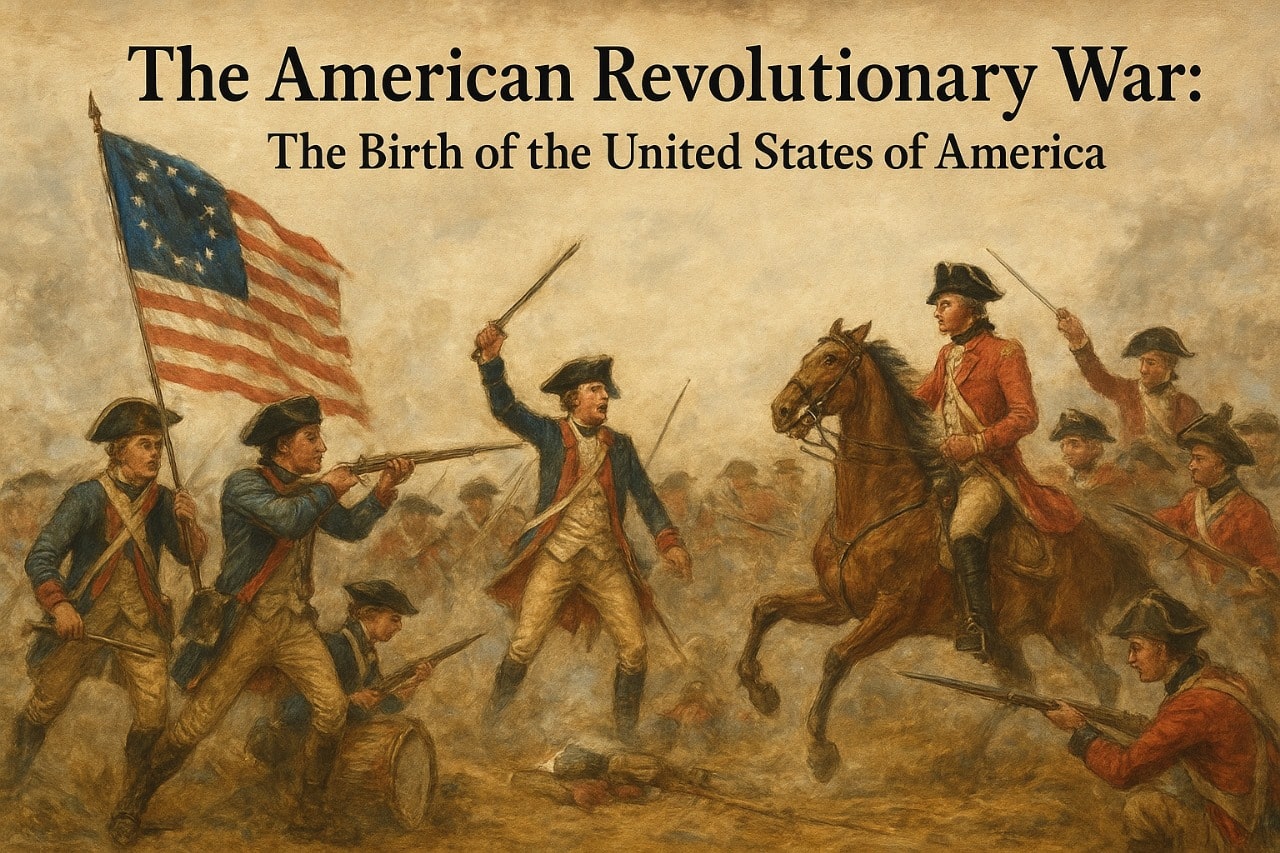
Introduction: The Dawn of a New Nation
The American Revolutionary War, fought between 1775 and 1783, stands as one of the most defining conflicts in world history. It was not merely a struggle for land or political power it was a revolution in thought, governance, and identity. This war marked the birth of the United States of America, transforming thirteen British colonies into an independent nation built on the ideals of liberty, equality, and self-determination. The American Revolution reshaped the global balance of power, inspiring similar movements across Europe and beyond. Understanding the Revolutionary War is essential to comprehending how a small collection of colonies rose against one of the most powerful empires in history and laid the foundation for modern democracy.
Background: Seeds of Discontent in the Thirteen Colonies
The roots of the American Revolution were planted decades before the first shots were fired. By the mid-18th century, Britain had established thirteen prosperous colonies along the eastern coast of North America. While these colonies enjoyed a degree of autonomy, their economic and political systems were tightly controlled by the British Crown. Tensions began to rise when Britain attempted to exert more direct control, primarily to recover from the financial burdens of the Seven Years’ War (1756–1763).
To recoup war expenses, Britain imposed a series of taxes on the colonies without granting them representation in Parliament. The Stamp Act (1765), the Townshend Acts (1767), and the infamous Tea Act (1773) were seen by many colonists as violations of their rights as Englishmen. The rallying cry of “No taxation without representation” echoed through the colonies, symbolizing their growing resistance. Events like the Boston Massacre (1770) and the Boston Tea Party (1773) further fueled anti-British sentiment, setting the stage for an inevitable confrontation.
The Spark of Revolution: Lexington and Concord (1775)
The Revolutionary War officially began in April 1775 with the Battles of Lexington and Concord in Massachusetts. British troops, under orders to confiscate colonial weapons, clashed with colonial militias known as the Minutemen. The first gunfire often called “the shot heard ’round the world” marked the beginning of open warfare. Though the British managed to destroy some military supplies, they suffered significant losses while retreating to Boston under continuous colonial fire.
These skirmishes demonstrated that the colonial militias were not only willing to fight but were capable of challenging the British Army. The event electrified the colonies, leading to widespread mobilization and the formation of the Continental Army, with George Washington appointed as its commander-in-chief by the Second Continental Congress in June 1775. What began as isolated resistance quickly evolved into a full-scale war for independence.
Declaration of Independence: The Birth of a New Nation (1776)
By 1776, the desire for complete separation from Britain had become undeniable. Influenced by Enlightenment ideals and revolutionary thinkers like John Locke, colonial leaders argued that legitimate government required the consent of the governed. On July 4, 1776, the Continental Congress adopted the Declaration of Independence, drafted primarily by Thomas Jefferson.
The document boldly declared that “all men are created equal” and endowed with “unalienable rights” including life, liberty, and the pursuit of happiness. It accused King George III of tyranny and justified rebellion as a moral necessity. The Declaration was not merely a statement of intent it was the philosophical foundation of a new nation and a direct challenge to monarchical rule across the globe.
This moment transformed the war’s character. It was no longer a rebellion against unfair taxes it was a fight for freedom, sovereignty, and self-determination.
Major Battles and Turning Points
The Battle of Bunker Hill (1775)
Although technically a British victory, the Battle of Bunker Hill proved the colonists could hold their own. American forces inflicted heavy casualties on British troops before being forced to retreat. This battle boosted colonial morale and signaled that the war would be far from an easy conquest for Britain.
The New York Campaign (1776)
After declaring independence, the Continental Army faced severe tests. British General William Howe launched a massive invasion of New York, defeating Washington’s army and capturing the city. Despite the loss, Washington’s strategic retreat preserved his army and prevented total collapse.
The Crossing of the Delaware and Battle of Trenton (1776)
In a bold move on Christmas night, 1776, Washington led his troops across the icy Delaware River to surprise Hessian forces in Trenton, New Jersey. The victory revitalized the revolution and proved Washington’s leadership and resilience under pressure.
The Saratoga Campaign (1777)
The Battle of Saratoga became the turning point of the war. American forces under General Horatio Gates and Benedict Arnold defeated British General John Burgoyne’s army in New York. This decisive victory convinced France to formally ally with the United States, providing crucial military and financial support that changed the course of the war.
The Southern Campaign and Battle of Yorktown (1781)
The final phase of the war unfolded in the southern colonies. After years of attrition, Washington, with French assistance under General Rochambeau and Admiral de Grasse, trapped British General Charles Cornwallis at Yorktown, Virginia. On October 19, 1781, Cornwallis surrendered, effectively ending major hostilities. The American victory at Yorktown sealed the fate of British colonial ambitions in North America.
International Involvement: A Global Conflict
The American Revolutionary War was not confined to the North American continent it became a global confrontation. The alliance with France in 1778 expanded the conflict to Europe, the Caribbean, and even India. Spain and the Dutch Republic also joined against Britain, seeking to weaken their imperial rival.
The French navy’s involvement was particularly decisive. By blockading British forces at Yorktown, the French ensured Washington’s victory. International support transformed the colonial rebellion into a legitimate war for independence, highlighting the interconnected nature of 18th-century geopolitics.
Life During the Revolution: Struggles on the Home Front
While soldiers fought on the battlefield, civilians faced their own trials. Families were torn apart, economies collapsed, and resources grew scarce. Many women took on unprecedented roles, managing farms, businesses, and even serving as spies and messengers. Figures like Abigail Adams, Molly Pitcher, and Deborah Sampson became symbols of female strength and patriotism.
The war also had a complex impact on enslaved Africans and Native Americans. Both sides courted their support, with Britain promising freedom to slaves who joined their cause. Many Native tribes allied with the British, fearing colonial expansion into their lands. In the aftermath of the war, however, most promises to these groups were broken, and the new nation struggled to reconcile its ideals of liberty with ongoing inequality.
The Treaty of Paris (1783): Recognizing Independence
After the defeat at Yorktown, Britain realized the futility of continuing the war. Negotiations began in Paris, leading to the signing of the Treaty of Paris on September 3, 1783. The treaty recognized the United States of America as a free and independent nation and established borders extending from the Atlantic Ocean to the Mississippi River.
The agreement also addressed issues such as fishing rights, the repayment of debts, and the treatment of Loyalists colonists who had supported the British Crown. The peace treaty officially ended eight years of conflict and ushered in a new era of self-governance and democratic experimentation.
The Formation of a New Government
Winning the war was only the first step. Building a functioning government from scratch was an even greater challenge. The Articles of Confederation (1781) served as the new nation’s first constitution but proved too weak to unify the states effectively. Economic instability, interstate disputes, and external threats exposed its flaws.
This led to the Constitutional Convention of 1787, where delegates drafted the United States Constitution, creating a balanced federal system with checks and balances. The Bill of Rights (1791) followed, guaranteeing essential freedoms such as speech, religion, and due process. The political innovations born from the revolution would influence democracies worldwide.
The War’s Global Impact and Legacy
The American Revolution reverberated far beyond North America. It challenged the legitimacy of absolute monarchy and inspired movements for independence and reform across the world. The French Revolution (1789), in particular, drew direct inspiration from America’s example of resistance and constitutional governance.
For Britain, the loss of the American colonies marked the beginning of a new imperial strategy shifting focus toward Asia, Africa, and the Pacific. Meanwhile, the newly established United States embarked on a journey of territorial expansion, economic growth, and evolving political identity.
The revolution also introduced enduring debates about freedom, equality, and human rights. Although the new nation did not immediately resolve issues like slavery and gender inequality, the ideals of the revolution laid the foundation for future reform movements that would continue to redefine American society.
Conclusion: The Birth of a Nation and the Legacy of Freedom
The American Revolutionary War was not just a military struggle it was a radical reimagining of governance, rights, and identity. Out of hardship, sacrifice, and determination, a new nation was born one that promised liberty and opportunity. The revolution’s leaders, soldiers, and citizens collectively forged the principles that continue to shape the modern world: democracy, individual rights, and the belief that government must derive its power from the consent of the governed.
The legacy of the American Revolution endures in every corner of the globe where people strive for freedom and self-determination. The United States, born from the fires of revolution, stands as a lasting testament to the power of ideas and the courage to defend them.
The birth of America was not the end of a struggle but the beginning of an experiment in liberty that continues to evolve today.