

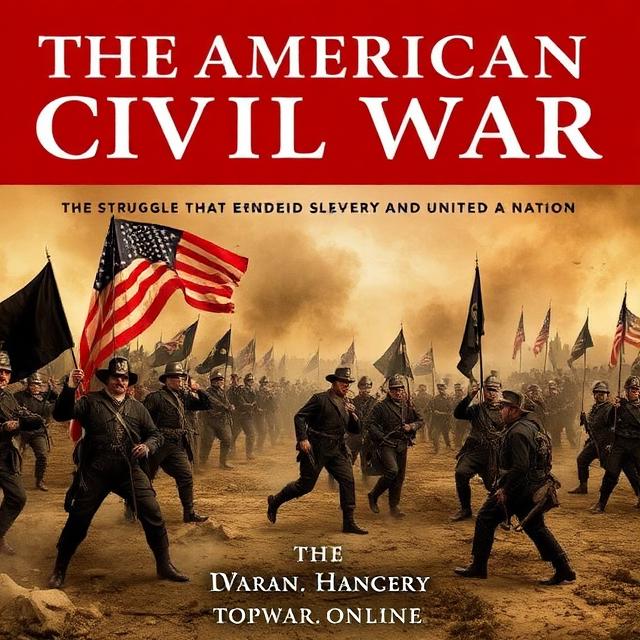
Introduction: A Nation on the Brink of Division
The American Civil War, fought between 1861 and 1865, stands as one of the most transformative conflicts in U.S. history. It was more than a mere military confrontation; it was a struggle over the fundamental principles upon which the United States was founded. At its core, the war represented a battle between the ideals of freedom and the institution of slavery, between state sovereignty and federal authority. The conflict ultimately reshaped the nation, leading to the abolition of slavery, a strengthened federal government, and the path toward civil rights, even though the journey was far from complete. Understanding this war requires examining the complex political, economic, and social tensions that had been simmering in the United States for decades.
Causes of the American Civil War
Slavery: The Central Contention
The institution of slavery was the most profound and contentious issue dividing the North and the South. While the Northern states gradually moved toward industrialization and had largely abolished slavery by the early 19th century, the Southern economy was heavily reliant on agriculture, particularly cotton, which depended on slave labor. Southern leaders viewed any attempt to limit slavery as an existential threat to their economic system and social order. The moral debate over slavery, combined with the South’s desire to preserve its “way of life,” made compromise increasingly difficult.
States’ Rights vs. Federal Authority
Southern states also championed the doctrine of states’ rights, asserting that each state had the power to govern itself without interference from the federal government. They feared that federal regulations, particularly those aimed at restricting or abolishing slavery, would erode their autonomy. In contrast, Northern politicians and citizens often viewed the preservation of the Union as paramount, believing that federal authority should supersede state laws when it came to national interests.
Expansion and the Missouri Compromise
As America expanded westward, the question of whether new territories would permit slavery heightened tensions. The Missouri Compromise of 1820 attempted to maintain a delicate balance by allowing Missouri as a slave state and Maine as a free state, while banning slavery in northern territories. While temporarily successful, these measures only postponed a more explosive confrontation. Later events, including the Kansas-Nebraska Act of 1854, inflamed regional hostilities and violence, such as the infamous “Bleeding Kansas” skirmishes between pro-slavery and anti-slavery settlers.
The Election of Abraham Lincoln
The election of Abraham Lincoln in 1860 marked the tipping point for Southern states. Lincoln, representing the anti-slavery Republican Party, opposed the expansion of slavery into new territories. Though he promised not to interfere with slavery where it already existed, Southern leaders viewed his election as a direct threat. Following Lincoln’s victory, seven Southern states seceded from the Union, forming the Confederate States of America, and the path to war became inevitable.
Key Figures of the Civil War
Abraham Lincoln: The Emancipator
Abraham Lincoln, the 16th President of the United States, played a pivotal role in guiding the nation through its darkest hour. Known for his eloquence and moral resolve, Lincoln navigated the treacherous political landscape to maintain Union unity. His leadership culminated in the issuance of the Emancipation Proclamation in 1863, which declared freedom for slaves in Confederate-held territories, signaling a moral and strategic turning point in the war.
Jefferson Davis: The Confederate President
Jefferson Davis served as the President of the Confederate States of America, leading the Southern cause with unwavering dedication to the principles of states’ rights and slavery. Davis faced immense challenges, including shortages of resources, internal political disagreements, and the formidable industrial and military might of the North. Despite his efforts, the Confederacy ultimately could not sustain the war effort against the better-equipped Union.
Military Leaders: Generals on Both Sides
The Civil War produced legendary military figures whose strategies and decisions shaped the course of the conflict. Union generals such as Ulysses S. Grant and William Tecumseh Sherman demonstrated aggressive tactics and relentless campaigns, ultimately wearing down Confederate resistance. On the Southern side, Robert E. Lee became an iconic figure for his tactical brilliance and unwavering commitment to the Confederate cause. These leaders, often revered and criticized in equal measure, left an indelible mark on military history.
Major Battles of the Civil War
The Battle of Fort Sumter
The first shots of the Civil War were fired at Fort Sumter in South Carolina in April 1861. Though relatively bloodless, the battle signaled the beginning of a long and devastating conflict. The Confederate attack on the Union garrison mobilized Northern forces and galvanized public opinion in favor of preserving the Union.
The Battle of Antietam
Fought in September 1862, the Battle of Antietam remains the bloodiest single-day battle in American history, with over 22,000 casualties. Though tactically inconclusive, the Union claimed a strategic victory that allowed Lincoln to issue the Emancipation Proclamation, transforming the war into a fight not just for the Union, but for human freedom.
The Battle of Gettysburg
The three-day Battle of Gettysburg in July 1863 was a turning point in the Civil War. Lee’s attempt to invade the North failed, resulting in heavy Confederate losses. The Union victory boosted Northern morale and marked the beginning of the Confederacy’s decline. Abraham Lincoln later honored the fallen soldiers in his famous Gettysburg Address, reaffirming the nation’s commitment to liberty and equality.
Sherman’s March to the Sea
General William Tecumseh Sherman’s campaign through Georgia in 1864 demonstrated the Union’s total war strategy, aimed at crippling the Confederacy’s economic and psychological capacity to fight. Sherman’s march destroyed infrastructure, disrupted supply lines, and weakened Southern morale, contributing significantly to the eventual Union victory.
Social and Economic Impacts of the War
The End of Slavery
The American Civil War fundamentally altered the social fabric of the nation. The 13th Amendment, ratified in December 1865, abolished slavery throughout the United States. This monumental legal change laid the groundwork for future civil rights advancements, although systemic racial inequality would persist for generations. The emancipation of millions of enslaved individuals represented both a moral victory and a profound societal transformation.
Economic Transformation
The war also accelerated the North’s industrial growth and weakened the Southern plantation economy. Infrastructure destruction, labor shortages, and financial ruin plagued the South, while Northern industries thrived by supplying wartime needs. This economic divergence contributed to the long-term reshaping of the American economy, accelerating urbanization and technological advancement.
Political Consequences
Politically, the Civil War solidified federal authority over the states, diminishing the power of secessionist movements and reinforcing the principle of a unified nation. Reconstruction policies attempted to integrate formerly enslaved people into society, though these efforts faced fierce resistance, giving rise to the Jim Crow era in the South. Nevertheless, the precedent of federal intervention set during the war has influenced American governance ever since.
Cultural and Historical Legacy
The Civil War left an indelible mark on American culture, inspiring countless books, films, and academic studies. It is remembered not only for its military campaigns but also for the profound moral questions it raised. Memorials, battlefields, and museums serve as enduring reminders of the sacrifices made and the ideals defended. The conflict also shaped national identity, emphasizing unity, justice, and the ongoing struggle for equality.
Conclusion: A Nation Forged in Conflict
The American Civil War was a transformative chapter in U.S. history, a brutal struggle that tested the nation’s commitment to its founding ideals. It ended the institution of slavery, preserved the Union, and laid the foundation for modern America. While the war’s immediate aftermath brought challenges, including Reconstruction and racial tensions, the legacy of the Civil War remains a testament to the resilience and moral evolution of the United States. Through understanding this pivotal conflict, we gain insight not only into the past but also into the enduring values of freedom, unity, and justice