

Introduction: The Rise of a Legend
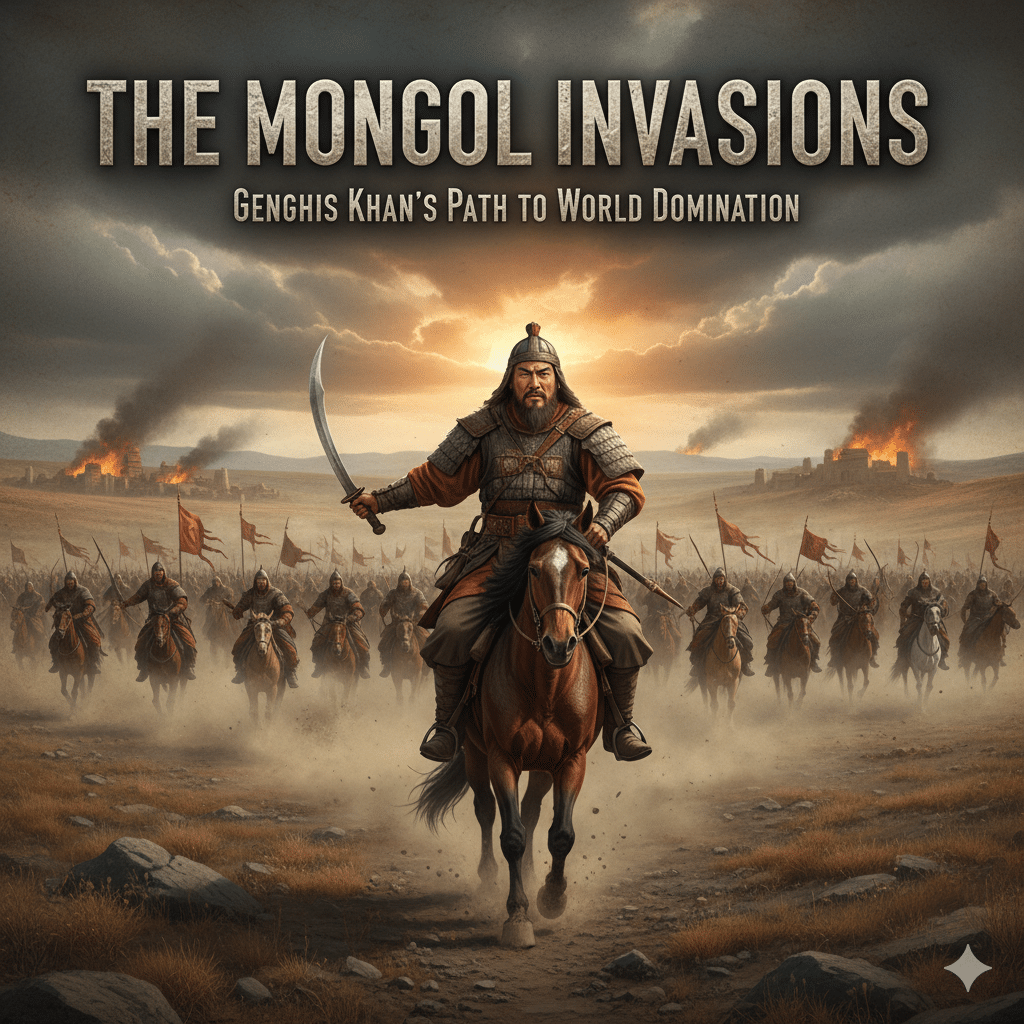
In the early 13th century, a nomadic horseman from the rugged steppes of Mongolia would change the course of human history. Temüjin, later known as Genghis Khan, united the warring Mongol tribes and unleashed a wave of conquests that stretched from the Pacific Ocean to the edge of Europe. The Mongol Invasions were not merely military campaigns they were a seismic transformation of civilizations, cultures, and economies across Eurasia.
By forging one of the largest contiguous empires in history, Genghis Khan shattered old world orders and created new pathways for trade, diplomacy, and cultural exchange. His story is one of brutal conquest and brilliant strategy, combining ruthless ambition with visionary state-building that left an indelible mark on the world.
1. The Steppe Origins of a Conqueror
The Mongol story began on the harsh, wind-swept grasslands of Central Asia, where survival demanded unity, strength, and adaptability. Born around 1162, Temüjin endured a childhood of betrayal, poverty, and struggle after his father’s death. Clan politics and nomadic rivalries shaped his worldview loyalty was fragile, and power had to be seized.
By his early adulthood, Temüjin had mastered the art of diplomacy and warfare, forging alliances with rival tribes through marriage, negotiation, and calculated violence. His rise was not only through battle but through charismatic leadership rewarding merit, promoting talent, and demanding loyalty. These principles laid the foundation for a new kind of empire.
2. Unification of the Mongol Tribes
Before Genghis Khan’s rise, the steppe was divided among dozens of nomadic clans, each with its own khan and its own ambitions. Temüjin’s greatest achievement was uniting these groups under a single banner a task that required both strength and cunning.
In 1206, after years of warfare, he was proclaimed “Genghis Khan,” meaning Universal Ruler, at a grand council called the kurultai. This event marked the birth of the Mongol Empire. The newly united Mongols were disciplined, fiercely loyal, and bound by a new legal code the Yassa which emphasized order, obedience, and military efficiency. With internal divisions crushed, Genghis Khan turned his gaze outward toward the richer civilizations beyond the steppe.
3. The Military Machine: Innovation and Discipline
The Mongol army was one of the most formidable fighting forces ever assembled. It was not the size of the army that terrified empires it was its organization, speed, and intelligence. Every soldier was trained from childhood in archery, horsemanship, and survival. The Mongols could travel up to 100 miles in a day, striking swiftly and unexpectedly.
Their weapons included the composite bow, far more powerful than European longbows, and tactical innovations such as feigned retreats, ambushes, and multi-directional assaults. Communication between units was maintained through signal flags, drums, and mounted couriers. This precision and mobility allowed the Mongols to annihilate armies many times their size.
4. The Fall of the Xi Xia and Jin Dynasties
Genghis Khan’s first major campaigns targeted northern China, then divided between the Xi Xia and Jin Dynasties. The Mongols, long viewed as barbaric outsiders, struck with unprecedented ferocity. Cities that resisted were razed; those that surrendered were spared and absorbed into the empire.
By 1215, the Mongols had captured Zhongdu (modern Beijing), signaling the fall of Jin power. Yet Genghis Khan did not destroy everything he conquered he incorporated Chinese engineers, siege experts, and administrators into his army and governance system. This blending of nomadic and sedentary knowledge became a hallmark of Mongol success, allowing them to defeat even the most fortified civilizations.
5. The Invasion of the Khwarazmian Empire
In 1219, the Khwarazmian Empire of Central Asia became Genghis Khan’s next target. Initially seeking trade relations, he sent a caravan of merchants only for the Khwarazmian governor to seize the goods and execute the envoys. Outraged by this act of betrayal, Genghis Khan launched one of history’s most devastating retaliations.
His armies swept across Bukhara, Samarkand, and Urgench, employing psychological warfare and total destruction. Cities that resisted were annihilated, populations massacred or enslaved. This campaign demonstrated the Mongols’ brutal efficiency and their understanding of terror as a strategic weapon ensuring future cities surrendered without resistance.
6. The Expansion into Persia and the Middle East
After the fall of Khwarazm, Mongol forces surged westward through Persia and into the Caucasus. Commanders such as Subutai and Jebe, Genghis Khan’s most trusted generals, conducted lightning campaigns across modern-day Iran, Azerbaijan, and Georgia. Their raids reached as far as Kiev and the Black Sea, shocking Europe with the sudden appearance of an unstoppable eastern power.
These campaigns showcased the Mongols’ ability to fight across diverse terrain from deserts to mountains while maintaining coordination across thousands of miles. For the Islamic world, the Mongol invasion marked the beginning of centuries of transformation and reorganization.
7. The European Encounter: Fear on the Horizon
Although Genghis Khan himself never invaded Europe, his generals laid the groundwork. Between 1220 and 1241, Mongol forces ravaged Russia, Poland, and Hungary, defeating European knights with terrifying ease. The battles of Liegnitz and Mohi in 1241 demonstrated that even heavily armored crusaders could not stand against Mongol mobility and tactics.
The sudden death of the Great Khan Ögedei, Genghis’s successor, spared Europe from a full-scale invasion, as Mongol leaders withdrew to select a new ruler. Yet the fear of Mongols the “horsemen of the apocalypse” haunted Europe for generations, altering military strategy and diplomacy across the continent.
8. Governance and the Yassa: Order in Chaos
While remembered for conquest, Genghis Khan was also a lawgiver and administrator. The Yassa, his codified set of laws, governed everything from military discipline to trade, marriage, and justice. It promoted religious tolerance, meritocracy, and severe punishment for betrayal or theft.
Under Mongol rule, traders and diplomats enjoyed protection, fostering the revival of the Silk Road. The empire became a vast network of exchange, where goods, technologies, and ideas traveled freely from China to the Mediterranean. Genghis Khan’s legal and administrative vision proved that even a nomadic empire could sustain a complex, global system.
9. The Mongol Successors and Global Expansion
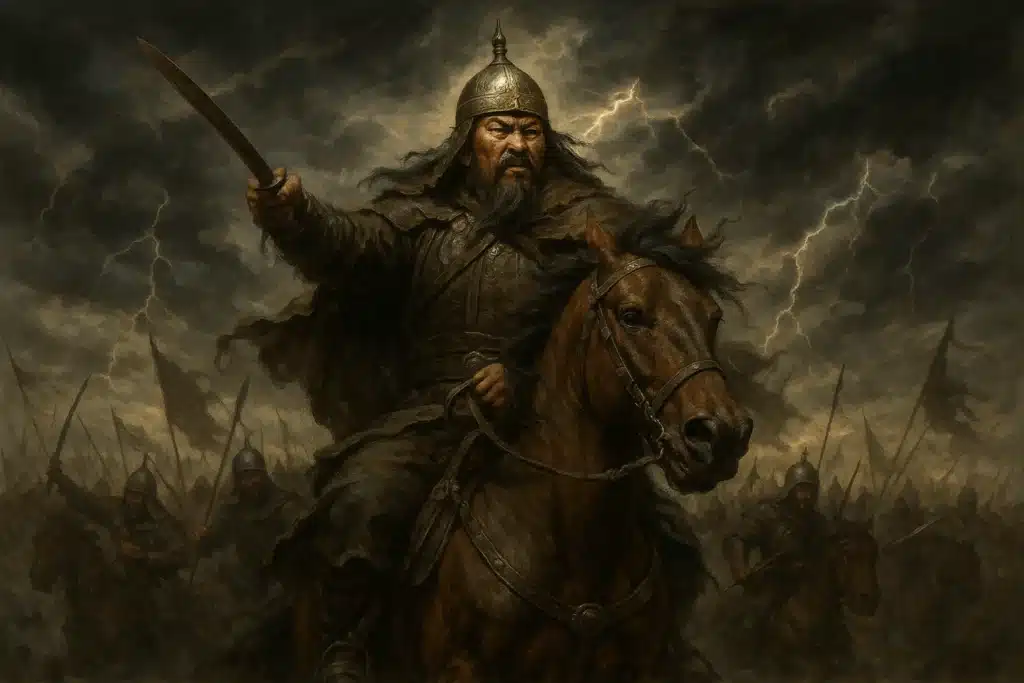
After Genghis Khan’s death in 1227, his empire did not crumble it expanded. His sons and grandsons divided the realm into four major khanates: the Yuan Dynasty in China, the Ilkhanate in Persia, the Chagatai Khanate in Central Asia, and the Golden Horde in Russia.
Each khanate adapted Mongol governance to local cultures, blending steppe traditions with Persian, Chinese, and Islamic influences. Under Kublai Khan, Genghis’s grandson, the Mongols completed the conquest of China and established the Yuan Dynasty (1271–1368), ruling as emperors from Beijing. This era marked the Mongols’ transition from nomadic conquerors to imperial administrators.
10. The Pax Mongolica: Trade, Travel, and Cultural Exchange
Despite their reputation for destruction, the Mongols also created a period of unprecedented peace and stability known as the Pax Mongolica (“Mongol Peace”). For nearly a century, merchants, scholars, and travelers could move safely across the empire’s trade routes.
The Silk Road thrived again, connecting Europe and Asia through a secure network of roads and relay stations (yam). Goods such as silk, spices, gunpowder, and paper spread westward, while scientific ideas and technologies flowed eastward. This global integration made possible the journeys of explorers like Marco Polo, who marveled at the sophistication of Kublai Khan’s court.
11. The Mongol Legacy: Destruction and Development
The Mongol Invasions brought unparalleled destruction cities burned, millions perished, and entire regions depopulated. Yet they also accelerated globalization and cultural fusion. The Mongols dismantled stagnant feudal systems, encouraged international trade, and transmitted innovations such as printing, gunpowder, and banking practices.
Their tolerance of religions from Christianity to Buddhism and Islam allowed diverse faiths to coexist under one empire. By integrating East and West, the Mongols laid the groundwork for the modern interconnected world, shaping diplomacy, commerce, and culture for centuries.
12. The End of the Empire and the Immortality of Genghis Khan
By the late 14th century, the vast Mongol Empire began to fragment under internal rivalries and local independence movements. Yet its legacy endured through successor states and the mythic memory of its founder. In Mongolia, Genghis Khan remains a national symbol of unity, strength, and destiny.
Modern historians view him not only as a conqueror but as a transformative world figure a man who, through vision and violence, reshaped Eurasia’s geography, economy, and culture. His empire may have fallen, but his influence lives on in every map, trade route, and empire that followed.
The Steppe Code: Loyalty, Merit, and Discipline
The Mongol Empire’s success was rooted in an unshakable internal code that valued loyalty and merit over birthright. Genghis Khan broke away from the traditional tribal hierarchies that favored noble lineage, instead promoting men based on their ability, bravery, and loyalty. This radical meritocracy unified warriors from rival clans and ensured that talent was never wasted. Every soldier, regardless of rank, knew that personal courage could lead to reward. This system gave the Mongols a deep sense of purpose and belonging, transforming a loose confederation of tribes into a cohesive and unstoppable military machine.
Espionage and Intelligence Networks
Long before modern intelligence agencies existed, Genghis Khan relied heavily on spies, scouts, and informants. His armies gathered vast amounts of information about enemy terrain, politics, and military strength before striking. The Mongols used merchants and travelers as covert agents, mapping routes, river crossings, and city fortifications. They also captured interpreters and defectors to gather insights into local customs and alliances. This superior intelligence network gave the Mongols an edge in every campaign, allowing them to strike with precision and often defeat enemies before battles even began.
Siege Warfare and the Science of Destruction
Although the Mongols were originally nomads unfamiliar with fortifications, they quickly mastered siege warfare. They adopted and improved Chinese siege technologies catapults, battering rams, and early gunpowder weapons and employed engineers from conquered lands. In battles for cities like Samarkand, Nishapur, and Kaifeng, Mongol armies demonstrated a terrifying mastery of urban assault. Their use of psychological warfare, including fake retreats and deliberate terror tactics, made many cities surrender without resistance. The Mongol art of siege blended technology, intelligence, and terror, redefining medieval warfare forever.
Psychological Warfare: Conquest Through Fear
Few armies in history understood fear as a weapon better than the Mongols. Genghis Khan deliberately crafted an image of invincibility and divine wrath, spreading stories of entire cities wiped from existence. When towns resisted, they faced total annihilation; when they surrendered, they were spared and rewarded. Word of these contrasting fates spread rapidly along trade routes, causing many cities to open their gates voluntarily. This strategy conserved Mongol manpower and accelerated conquest. In effect, Genghis Khan ruled through a blend of awe and terror, making fear itself his most effective general.
The Role of Diplomacy and Trade Alliances
While warfare defined his empire’s rise, Genghis Khan was equally skilled in diplomacy and commerce. He established alliances with foreign powers, such as the Uyghur Kingdom, which provided literacy and bureaucratic expertise for Mongol administration. Diplomats carried messages and peace proposals across continents, protected by the Yassa’s decree that harming envoys was punishable by death. Genghis Khan also prioritized the safety of merchants, offering tax incentives and safe passage along the Silk Road. His pragmatic diplomacy ensured that even as he conquered, he was also building a web of economic interdependence.
The Women Behind the Empire
Mongol women played crucial roles in the empire’s governance, logistics, and survival. While men campaigned, women managed trade, herds, and family affairs ensuring the Mongol economy functioned smoothly. Powerful figures such as Hoelun (Genghis Khan’s mother) and Börte (his wife) shaped political alliances and maintained stability among rival clans. Later, queens and princesses ruled territories, led negotiations, and acted as regents. The relative equality of Mongol society allowed women to exercise authority unseen in most medieval cultures. Their resilience and leadership were integral to the empire’s continuity and cohesion.
Religious Tolerance and Cultural Fusion
Unlike many conquerors, Genghis Khan practiced remarkable religious tolerance. Shamanism was the Mongols’ native belief system, but the empire encompassed Buddhists, Christians, Muslims, and Taoists all of whom were free to worship. The Great Khan believed that every faith sought the same truth and that divine favor could come through any religion. This policy not only reduced rebellion but also fostered cross-cultural exchange among scholars, clerics, and artisans. Under Mongol patronage, ideas traveled as freely as goods, helping to create one of the most culturally interconnected eras in world history.
Administration and Taxation: The Foundations of Empire
Genghis Khan’s genius extended beyond the battlefield into administration and governance. He created a postal relay system (yam) with stations across the empire, enabling rapid communication. Census systems were introduced to manage taxation and military conscription. Local rulers who pledged loyalty could remain in power, while Mongol overseers ensured obedience and fairness. This decentralized but efficient model allowed the Mongols to rule vast territories with minimal bureaucracy. Their tax reforms encouraged productivity and trade, making the empire not just a dominion of conquest but a functioning economic powerhouse.
The Spread of Knowledge and Technology
Under the Mongols, knowledge flowed more freely than ever before. Scholars, artisans, and physicians moved across the empire, sharing innovations in medicine, astronomy, cartography, and engineering. Chinese printing techniques and gunpowder reached the Islamic world and eventually Europe. Persian administrative practices influenced Mongol governance, while Mongol postal systems inspired later imperial communication models. The empire acted as a conduit for the global exchange of ideas, linking civilizations that had previously existed in isolation. In many ways, the Mongols accelerated humanity’s first true age of globalization.
The Black Death and the Decline of Empire
Ironically, the very trade routes that brought wealth and knowledge also spread catastrophe. During the mid-14th century, the Black Death (Bubonic Plague) spread along Mongol trade networks from China to Europe, killing tens of millions. The pandemic shattered populations and economies, weakening Mongol control. As local rulers asserted independence and rival khanates warred among themselves, the once-mighty empire fractured. By the late 1300s, Mongol dominance had faded, leaving behind successor states each carrying traces of the Great Khan’s legacy. The empire had ended, but its influence would echo for centuries.
The Mongol Influence on Europe and the Renaissance
Though Europeans initially viewed the Mongols as a terrifying threat, their long-term influence was profound. The opening of trade routes under Mongol rule introduced Europeans to luxury goods, scientific knowledge, and new worldviews. Italian merchants, including the Polo family, ventured eastward, paving the way for later exploration. Contact with the advanced civilizations of the East helped inspire Europe’s intellectual revival, culminating in the Renaissance. The Mongol Empire indirectly connected Europe with Asia’s innovations a cultural awakening born from conquest.
The Eternal Spirit of Genghis Khan
Centuries after his death, Genghis Khan’s legend remains alive. In Mongolia, his image is revered as a symbol of unity, resilience, and national pride. Globally, historians debate whether he was a barbaric destroyer or a visionary leader who laid the foundations of the modern world. His empire reshaped geopolitics, trade, and cultural exchange on an unprecedented scale. From the ruins of ancient cities to the living memory of nations, the mark of the Mongol invasions is still visible. Genghis Khan’s spirit endures not as a mere conqueror, but as the architect of a connected world.
Conclusion: The Horseman Who Changed the World
The Mongol Invasions under Genghis Khan were more than a military phenomenon; they were a turning point in human civilization. From the steppes of Mongolia to the gates of Europe, his conquests redrew boundaries, shattered kingdoms, and united the largest land empire ever known.
Genghis Khan’s story encapsulates the duality of empire creation through destruction, order born from chaos. His strategies, administration, and vision of a connected world anticipated the global age centuries before it began. The world that emerged after him was irreversibly transformed faster, larger, and more connected a world that still rides, in spirit, on the hoofbeats of the Mongol horsemen.