

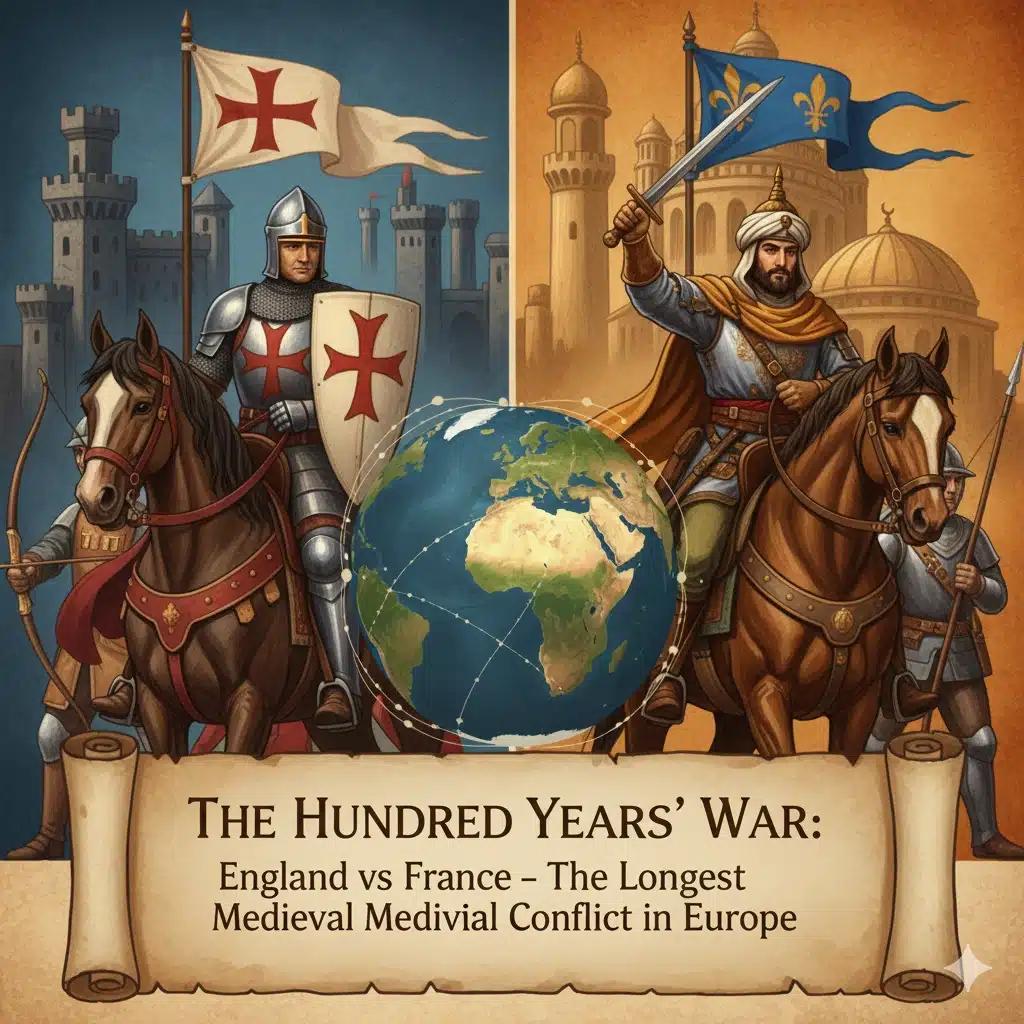
Introduction: A Century of Turmoil in Medieval Europe
The Hundred Years’ War was one of the longest and most transformative conflicts in European history, lasting from 1337 to 1453. Fought between the kingdoms of England and France, it spanned five generations, reshaped both nations, and forever altered the medieval world. What began as a dynastic dispute over the French throne evolved into a massive struggle for power, national identity, and sovereignty.
This epic war saw kings and peasants, knights and mercenaries, saints and traitors all caught in a web of ambition, loyalty, and bloodshed. It witnessed the rise and fall of great dynasties, the decline of feudalism, and the dawn of nationalism. From the legendary victories of Edward III and Henry V to the miraculous rise of Joan of Arc, the Hundred Years’ War stands as a defining chapter in the making of modern Europe.
The Causes of Conflict: A Battle for the French Crown
The roots of the Hundred Years’ War lay in dynastic rivalry and feudal politics. When the French King Charles IV died in 1328 without a direct male heir, a succession crisis erupted. The French nobility rejected the claim of Edward III of England, grandson of Philip IV of France through his mother, on the grounds that succession could not pass through the female line. Instead, they crowned Philip VI, a cousin of the deceased king.
Edward III initially accepted this decision, but tensions grew when Philip VI supported Scotland, England’s traditional enemy, and confiscated the English-held duchy of Aquitaine in 1337. Enraged, Edward declared himself the rightful King of France igniting a conflict that would last 116 years. The war was not merely about a throne; it was about prestige, power, and the control of rich territories across France.
The Feudal Landscape: Knights, Castles, and Chivalry
In the 14th century, Europe was still dominated by the feudal system, where loyalty and land defined social order. The Hundred Years’ War epitomized this feudal world filled with armored knights, massive fortresses, and elaborate codes of chivalry. Yet beneath the romantic image of honor and gallantry lay a brutal reality of scorched earth tactics, pillage, and famine.
English and French armies ravaged towns, burned crops, and devastated entire regions. Civilians suffered immensely as shifting allegiances and invasions disrupted local life. Over time, the war revealed that chivalry could not withstand the brutal efficiency of emerging gunpowder weapons and the rise of professional soldiers. The medieval order was slowly giving way to a more modern, centralized state.
The Early English Victories: Crécy and Poitiers
England’s early victories were legendary and owed much to superior tactics and technology. At the Battle of Crécy (1346), Edward III’s forces, though outnumbered, crushed the French cavalry through disciplined formations and the devastating power of the English longbow. This new weapon, capable of piercing armor at long range, rendered traditional knightly charges obsolete.
Nine years later, at Poitiers (1356), Edward’s son, known as the Black Prince, captured the French King John II, dealing another humiliating blow to France. The subsequent Treaty of Brétigny (1360) granted England vast territories and temporary peace. These victories marked the zenith of English power in the war and showcased a shift from feudal levies to organized, professional armies.
The Role of the Black Death and Economic Crisis
The Black Death (1347–1351) devastated Europe during the early stages of the war, killing nearly one-third of the population. The pandemic brought temporary halts to warfare but also deep economic and social changes. Labor shortages empowered peasants, undermined the feudal system, and led to uprisings such as the Peasants’ Revolt (1381) in England and the Jacquerie (1358) in France.
These internal disruptions weakened both kingdoms. England faced growing resentment over war taxes, while France struggled to rebuild its shattered economy and resist English occupation. Yet paradoxically, the shared suffering also forged a new sense of national identity the idea that people belonged not just to a lord but to a country worth defending.
The French Resurgence under Charles V
After a period of English dominance, the tide began to turn under Charles V of France (1364–1380), known as Charles the Wise. Through strategic brilliance and the leadership of his general Bertrand du Guesclin, France gradually regained its lost territories. Charles avoided direct battles, relying instead on guerrilla tactics, sieges, and attrition.
His diplomatic skill and administrative reforms strengthened the French monarchy. Under his rule, France re-established a professional standing army and improved taxation systems. This phase marked the beginning of France’s recovery and the decline of England’s territorial gains showing that patience, strategy, and national unity could overcome even the most crushing defeats.
The Lancastrian Phase: Henry V and the Battle of Agincourt
The war’s most famous chapter came under Henry V of England, whose reign reignited English ambition in France. In 1415, Henry invaded with a disciplined army, claiming both the French crown and divine favor. His stunning victory at the Battle of Agincourt became legendary. Against overwhelming odds, English longbowmen annihilated French knights bogged down in mud, armor, and confusion.
Agincourt symbolized the triumph of tactical innovation over aristocratic pride. It also made Henry V a national hero and solidified England’s dominance once again. The subsequent Treaty of Troyes (1420) recognized Henry as heir to the French throne and married him to Catherine of Valois, uniting both crowns in theory. But Henry’s early death in 1422 left his infant son Henry VI too young to maintain this fragile empire.
The Rise of Joan of Arc: Faith and Nationalism Reborn
Amid despair and occupation, a young peasant girl from Domrémy, Joan of Arc, emerged as a divine symbol of French resistance. Claiming to be guided by heavenly visions, Joan convinced Charles VII to let her lead an army to lift the siege of Orléans in 1429. Her courage and conviction turned the tide.
Joan’s victories restored French morale and paved the way for Charles VII’s coronation at Reims Cathedral, fulfilling her prophecy. Yet her triumph was short-lived captured by the Burgundians, she was handed over to the English, tried for heresy, and burned at the stake in 1431. Her martyrdom ignited a national awakening that would drive the English from France within two decades. Today, Joan of Arc stands as a timeless symbol of faith, courage, and patriotism.
The Role of Burgundian Alliances and Internal Divisions
One of the most complex aspects of the Hundred Years’ War was the role of internal alliances and civil strife. The powerful Duchy of Burgundy, sometimes allied with England, sometimes with France, played a decisive role in the conflict’s shifting balance. The feud between Burgundians and Armagnacs plunged France into civil war, weakening it at crucial moments.
These divisions highlight how the war was not just England vs. France, but also French vs. French. Yet by the 1430s, Charles VII successfully reconciled with Burgundy, unifying the kingdom and turning the full force of France against the English. This unity was instrumental in reclaiming lost territories and restoring the French monarchy’s strength.
The Dawn of Gunpowder and Modern Warfare
By the later stages of the war, the medieval art of battle was undergoing a revolution. The introduction of gunpowder weapons, cannons, and handguns transformed siege warfare and rendered traditional fortifications obsolete. French forces under Charles VII made full use of these innovations, systematically recapturing English strongholds.
The decisive victory at Castillon (1453), often regarded as the final battle of the Hundred Years’ War, demonstrated the effectiveness of artillery against outdated English tactics. With the fall of Bordeaux soon after, England’s continental ambitions collapsed leaving only the port of Calais under English control until 1558.
The End of the War and Its Consequences
The Hundred Years’ War ended not with a treaty but through exhaustion. France emerged victorious, its monarchy centralized and its people united under a growing sense of national pride. England, meanwhile, plunged into political chaos the Wars of the Roses (1455–1487) as rival factions fought for power in the aftermath of defeat.
The conflict had reshaped both kingdoms. Feudal lords lost influence to stronger monarchs; professional armies replaced knightly levies; and new technologies redefined warfare. For ordinary people, the war brought suffering but also transformation, as national consciousness replaced feudal loyalty.
Cultural and Economic Impact of the Hundred Years’ War
Beyond the battlefield, the war left deep marks on European culture and economy. Trade routes shifted, industries such as cloth production and metallurgy expanded, and wartime innovations stimulated technological progress. Chroniclers like Jean Froissart immortalized the conflict in vivid prose, blending historical fact with literary flair.
The devastation of rural France led to agricultural reform and urban growth, while England turned increasingly toward maritime trade and exploration. The long war had drained both nations, but it also gave birth to new forms of governance, taxation, and national identity that would shape Europe for centuries to come.
Legacy: From Feudal Kingdoms to Emerging Nations
The true legacy of the Hundred Years’ War lies in the birth of the nation-state. Before the conflict, “England” and “France” were collections of feudal territories; afterward, they became coherent political and cultural entities. The war fostered early patriotism, national symbols, and collective identity.
It also marked the beginning of the end for the medieval world. The dominance of knights and castles faded before the rise of professional soldiers, gunpowder, and centralized monarchies. By the mid-15th century, Europe was entering the Renaissance a new age built on the ashes of medieval warfare.
1. The Dynastic Web of Royal Claims
The roots of the Hundred Years’ War stretch back through generations of royal marriages and alliances that tied the fates of England and France together. English kings held vast lands in France a legacy of William the Conqueror’s Norman inheritance. By the 14th century, English monarchs like Edward III saw themselves not only as kings of England but also as feudal lords of French territories. This dual identity caused deep political friction, as the French crown sought to consolidate power and end foreign control within its borders. Thus, what began as a question of lineage and inheritance became a struggle over sovereignty itself.
2. The Importance of Aquitaine and the Economic Stakes
The duchy of Aquitaine, one of the largest and wealthiest regions of medieval France, was central to the conflict. Aquitaine’s fertile lands, vineyards, and Atlantic ports made it an economic prize for both crowns. For England, it was vital to its wine trade and maritime economy, while France viewed English possession as an insult to national unity. The loss or gain of this region was not merely symbolicit directly affected commerce, taxation, and royal wealth. The prolonged struggle for Aquitaine revealed that the Hundred Years’ War was as much about economic dominance as about dynastic legitimacy.
3. The Role of the Longbow: England’s Deadly Advantage
The English longbow became one of the most iconic weapons in medieval history due to its decisive role in battles like Crécy, Poitiers, and Agincourt. Requiring years of training, English archers could unleash a deadly rain of arrows capable of piercing armor and disrupting cavalry charges. This innovation symbolized a shift in military tactics from aristocratic duels to mass warfare, where common soldiers could change the course of battles. The longbow not only gave England a technological edge but also represented a social transformation empowering yeomen and diminishing the dominance of mounted knights.
4. Chivalry and the Changing Code of War
The Hundred Years’ War began as a conflict defined by chivalric ideals honor, bravery, and noble conduct. Knights saw war as a means of glory, ransom, and reputation. However, as the war dragged on, chivalry gave way to ruthless pragmatism. Raids known as chevauchées devastated the countryside, targeting civilians and infrastructure to weaken enemy morale. The transformation from gallant tournaments to total war marked the decline of the medieval warrior ethos. By the end of the conflict, warfare had become less about individual heroism and more about national survival and organized military power.
5. The Role of the Church and Religion
Religion played a powerful, complex role throughout the Hundred Years’ War. Both England and France claimed divine support, framing their causes as righteous and sanctioned by God. The Catholic Church, caught between the two Christian kingdoms, tried to mediate peace but often became a political pawn. The Great Schism (1378–1417), during which rival popes in Avignon and Rome divided Christendom, further complicated loyalties. Joan of Arc’s divine visions later reinvigorated France’s religious and national unity, illustrating how faith and warfare intertwined in the medieval imagination.
6. The Peasantry and the Human Cost of War
While kings and nobles fought for power, it was the peasants who bore the heaviest burden. Continuous warfare devastated farmlands, displaced villages, and caused famine and disease. Mercenary bands known as free companies roamed the countryside, looting and killing at will when not employed by either crown. Peasant uprisings, such as the Jacquerie in France and the Peasants’ Revolt in England, were desperate responses to oppression, taxation, and economic collapse. The Hundred Years’ War thus became not just a struggle between nations, but also a crucible of suffering for millions of ordinary people.
7. The Role of Propaganda and National Identity
The war coincided with the birth of national propaganda. Monarchs began using heraldry, songs, and literature to inspire patriotism and demonize the enemy. English kings claimed to be defenders of true monarchy and justice, while French leaders portrayed themselves as guardians of divine order and liberty. Chroniclers like Jean Froissart romanticized the deeds of knights, turning them into national heroes. By the end of the war, people no longer saw themselves merely as vassals of a lord they saw themselves as Englishmen or Frenchmen, loyal to a nation rather than a feudal bond.
8. The Rise of Professional Armies
The Hundred Years’ War accelerated the decline of feudal levies and the rise of standing professional armies. Both England and France began employing paid soldiers, mercenaries, and specialists like archers, engineers, and artillerymen. This transformation demanded efficient taxation and administration pushing monarchs toward greater central authority. France’s eventual victory was due in part to Charles VII’s reforms, which created a permanent army and reliable funding system. This shift marked a turning point in European history, laying the groundwork for the modern state-controlled military.
9. The Political Aftermath in England
England’s defeat in the Hundred Years’ War left deep political scars. The loss of continental territories weakened royal prestige and ignited internal strife. Discontent over war costs, taxation, and failed leadership culminated in the Wars of the Roses (1455–1487) a brutal civil war between the rival houses of Lancaster and York. This period of instability ended only with the rise of the Tudor dynasty under Henry VII. Thus, while France emerged stronger, England turned inward, focusing on rebuilding and redefining its power through naval exploration and future empire-building.
10. The Transformation of the French Monarchy
For France, the Hundred Years’ War was both a near-death experience and a rebirth. The monarchy of Charles VII and later Louis XI consolidated power, ending the semi-independent rule of great nobles like Burgundy. Royal armies, taxes, and bureaucracy strengthened central control. The French crown emerged as a symbol of unity and divine authority, while the humiliation of earlier defeats fueled a fierce sense of patriotism. The war’s end marked the beginning of France’s rise as a dominant European power, a trajectory that would continue into the Renaissance and beyond.
11. The Influence of Women and Court Politics
Beyond Joan of Arc, many women shaped the politics and diplomacy of the Hundred Years’ War. Isabella of France, mother of Edward III, played a pivotal role in England’s royal succession and early ambitions. Queens, duchesses, and noblewomen often acted as regents, diplomats, and financiers, managing estates and forging alliances while men were at war. Their correspondence, marriages, and influence on royal policy underscore the hidden power of women in medieval politics a subject often overshadowed by battlefield heroics but essential to understanding the era’s complexity.
12. The Enduring Legacy of the Hundred Years’ War
Even after the last battle ended in 1453, the echoes of the Hundred Years’ War continued to shape European politics, art, and identity. The conflict marked the end of medieval feudalism and the beginning of the modern age of nations. It influenced literature from Shakespeare’s Henry V to modern historical epics and remains a powerful symbol of endurance, pride, and tragedy. Most importantly, it taught Europe the devastating cost of prolonged war and the necessity of unity and diplomacy. The Hundred Years’ War, though centuries past, still speaks to the timeless themes of ambition, resilience, and the human spirit’s capacity for renewal.
Conclusion: The War That Forged Modern Europe
The Hundred Years’ War was far more than a contest for a crown. It was a crucible in which medieval Europe transformed into the modern world. Its heroes Edward III, the Black Prince, Henry V, and Joan of Arc became legends, its battles changed the nature of warfare, and its outcome defined the political boundaries of Western Europe.
From the ashes of this century-long struggle rose two powerful nations England and France whose rivalry would continue to shape global history for centuries. The Hundred Years’ War reminds us that even the longest conflicts can give birth to unity, progress, and the enduring idea of national identity.