
Introduction: The Call to War in the Name of Faith
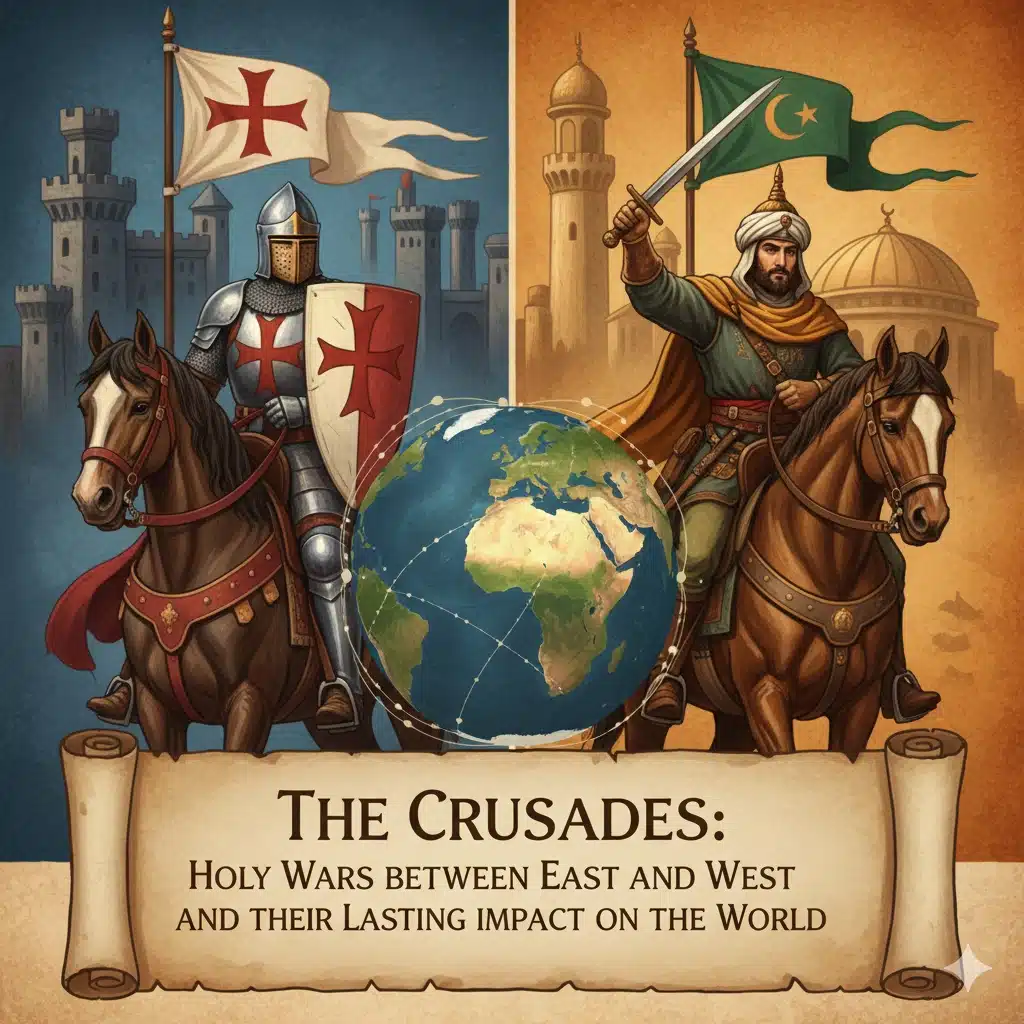
Few events in human history have shaped the relationship between East and West as profoundly as the Crusades. These were a series of religiously motivated wars fought between Christian Europe and the Muslim world from the late 11th to the 13th century. The Crusades were more than mere military expeditionsthey were a fusion of faith, politics, culture, and conquest, born from deep religious fervor and the desire to control the Holy Land, especially the city of Jerusalem.
Over two centuries, waves of crusaders from across Europe marched to the East, driven by promises of spiritual salvation, adventure, and wealth. In return, Muslim powers led by legendary figures such as Salah al-Din (Saladin) defended their lands with valor and strategy. The resulting clashes between Christianity and Islam transformed medieval society and reshaped global history, leaving a legacy that continues to influence modern geopolitics and interfaith relations.
The Roots of the Crusades: Religion, Power, and Politics
The origins of the Crusades can be traced to a combination of religious devotion and political ambition. In 1095 CE, Pope Urban II delivered a powerful sermon at the Council of Clermont, calling on Christian knights to liberate the Holy Land from Muslim rule. His speech electrified Europe. The Pope promised remission of sins for those who took up the crossa guarantee of spiritual reward that ignited mass enthusiasm.
However, behind the spiritual appeal lay political motives. The Byzantine Empire, threatened by Turkish advances, had requested help from the West. Pope Urban saw an opportunity to unite the warring kingdoms of Europe under the banner of Christianity and to expand the influence of the Catholic Church. Thus began the First Crusade, the most successful and impactful of them all.
The First Crusade (1096–1099): The Conquest of Jerusalem
The Journey to the East
The First Crusade brought together tens of thousands of peoplenobles, peasants, and soldierswho set out from Western Europe toward the Holy Land. The journey was perilous, with disease, hunger, and internal conflict claiming countless lives. Yet the crusaders’ religious zeal remained unbroken.
After years of brutal campaigning, the crusaders reached Jerusalem in 1099. In one of the most infamous episodes of medieval warfare, they stormed the city and massacred thousands of Muslim and Jewish inhabitants. Though violent and tragic, this victory established several Crusader States, including the Kingdom of Jerusalem, marking the high point of Christian power in the Middle East.
The Establishment of Crusader Kingdoms
Following the conquest, the crusaders fortified cities and built castles across the Levant to defend their new territories. These states became cultural and economic crossroads, where Europeans, Arabs, and Byzantines interacted, traded, and exchanged ideas. Yet the peace was fragile. The Muslim world, fragmented at first, began to unite under powerful leaders determined to reclaim their lost lands.
The Muslim Response and the Rise of Saladin
The Reunification of the Islamic World
In the decades following the First Crusade, the Muslim world began to recover from its divisions. By the mid-12th century, a charismatic and visionary leader emerged: Salah al-Din al-Ayyubi, known in the West as Saladin. He unified Egypt and Syria under his rule, rallying Muslim forces against the Christian Crusaders. Saladin was not only a brilliant general but also a chivalrous leader, admired even by his enemies for his honor and magnanimity.
The Battle of Hattin and the Fall of Jerusalem (1187)
In 1187, Saladin achieved one of the greatest victories in medieval history at the Battle of Hattin, where he crushed the Crusader army and recaptured Jerusalem. His treatment of prisoners and civilians was remarkably humane compared to earlier Christian conquests. The fall of Jerusalem shocked Europe and led to the launch of the Third Crusadea conflict that would bring together two legendary figures: Richard the Lionheart of England and Saladin.
The Third Crusade (1189–1192): The Clash of Kings
Richard the Lionheart and Saladin Face Off
The Third Crusade, often called the King’s Crusade, brought together Europe’s most powerful monarchsRichard I of England, Philip II of France, and Frederick Barbarossa of the Holy Roman Empire. Although Barbarossa died en route, Richard and Philip reached the Holy Land and captured the coastal city of Acre after a long siege.
The conflict between Richard and Saladin became the stuff of legendtwo noble warriors fighting with courage and mutual respect. Despite several victories, Richard failed to retake Jerusalem. Ultimately, in 1192, the two leaders signed a truce allowing Christian pilgrims safe passage to the Holy City while leaving it under Muslim control. This diplomatic resolution highlighted the possibility of coexistence amid warfare.
The Later Crusades: Decline and Disillusionment
After the Third Crusade, enthusiasm waned. Subsequent Crusades lacked the unity and idealism of earlier efforts. The Fourth Crusade (1202–1204), for instance, never reached the Holy Land. Instead, the crusaders were diverted to Constantinople, which they captured and brutally sackeda shocking betrayal of fellow Christians. This event deepened the divide between the Catholic West and the Orthodox East, a rift that remains significant in Christian history.
Later Crusades in North Africa and the Baltic region achieved limited success, and by the 13th century, the Crusader States had fallen one by one. The final Christian outpost, Acre, was lost in 1291, marking the end of the Crusading era in the Holy Land.
The Cultural Exchange Between East and West
Despite the bloodshed, the Crusades had far-reaching cultural consequences. The prolonged contact between Muslims, Christians, and Jews facilitated an exchange of knowledge, technology, and ideas. Crusaders returning from the East brought back innovations in medicine, mathematics, architecture, and navigation.
European exposure to advanced Islamic scholarship and urban culture helped spark the Renaissance centuries later. The Crusades also opened up trade routes between Europe and Asia, paving the way for global exploration and the eventual Age of Discovery. In this sense, the Crusades, though born of war, indirectly contributed to the growth of science, art, and commerce in Europe.
The Economic and Political Impact of the Crusades
The Crusades reshaped Europe’s economy and political landscape. The need to finance long military campaigns led to the growth of banking systems, while Italian city-states like Venice and Genoa prospered through trade with the East. Nobles who sold lands to fund their expeditions weakened the feudal system, allowing monarchies to consolidate power.
For the Muslim world, the Crusades prompted political unification and the strengthening of Islamic leadership. Economically, the trade that developed through crusader ports in the Levant revitalized regional markets. Both civilizations, despite the conflict, became more interconnected than ever before.
The Role of Religion: Faith as Both a Weapon and a Bond
Religion was at the heart of the Crusades. For Europeans, it was a sacred duty to defend Christianity and reclaim Jerusalem, while for Muslims, it became a jihada struggle to protect their faith and homeland. The wars were justified by both sides through religious language, yet they also led to introspection.
The Crusades demonstrated how faith could unite people toward a common cause, but also how easily it could be manipulated for political or material gain. Over time, the brutality of the wars forced theologians and leaders to reconsider the moral implications of violence in the name of religiona debate that continues in modern times.
The Byzantine Empire: Between Ally and Victim
The Byzantine Empire played a complex role in the Crusades. Initially seeking Western help against the Seljuk Turks, Byzantium found itself both a partner and a victim of the Crusaders. The relationship deteriorated, culminating in the sack of Constantinople during the Fourth Crusade. This event irreparably weakened the empire, paving the way for its eventual fall to the Ottoman Turks in 1453.
The betrayal of Constantinople marked a turning point in Christian unity. It also shifted the balance of power, making the rise of the Ottoman Empire inevitable and transforming the geopolitics of Eastern Europe for centuries.
The Legacy of Saladin and Richard the Lionheart
Among the many figures of the Crusades, Saladin and Richard the Lionheart stand out as symbols of courage, honor, and leadership. Their rivalry was fierce, yet both men respected each other deeply. Saladin’s chivalry earned him admiration in Europe, while Richard’s bravery made him a legend.
Their conduct contrasted sharply with the often ruthless nature of medieval warfare. Even today, they are remembered as warriors who embodied the ideals of nobility and respect across religious dividesa rare example of humanity amid chaos.
The Long-Term Impact on East–West Relations
The Crusades left an enduring mark on relations between the Islamic and Christian worlds. They deepened mistrust and created cultural stereotypes that persisted for centuries. However, they also initiated dialogue and exchange, laying the groundwork for future diplomacy and coexistence.
The lessons of the Crusades continue to resonate in modern timesserving as a reminder of how religious and cultural misunderstanding can lead to prolonged conflict. Yet they also show that reconciliation is possible through shared respect and learning.
1. The Social Upheaval in Medieval Europe
The Crusades dramatically reshaped the social fabric of medieval Europe. When thousands of knights and peasants left for the Holy Land, Europe underwent a temporary power shift. Many noble families lost their heirs in distant wars, leading to the redistribution of lands and titles. This weakened the feudal system and increased the authority of monarchs and the Church. Additionally, the crusading movement gave the lower classes new opportunities for adventure, social mobility, and wealth. For the first time, a peasant could earn honor and spiritual reward alongside nobles an idea that subtly challenged Europe’s rigid social hierarchy.
2. The Role of the Catholic Church in Mobilizing Europe
The Catholic Church was the true driving force behind the Crusades. By granting indulgences forgiveness of sins for those who fought the Church transformed warfare into a spiritual mission. Popes like Urban II and Innocent III used the Crusades to consolidate religious authority and unite the fractious kingdoms of Europe under one divine purpose. The Church’s ability to mobilize entire nations demonstrated its unparalleled influence. Yet, this also sowed the seeds of future dissent, as many began questioning whether war could truly serve the will of God, leading centuries later to movements of reform and reexamination of faith.
3. The Role of Military Orders: Knights Templar and Hospitallers
One of the most fascinating outcomes of the Crusades was the rise of military-religious orders like the Knights Templar, Knights Hospitaller, and Teutonic Knights. These warrior monks combined monastic discipline with martial prowess, defending pilgrims and holy sites in the East. The Templars, in particular, became immensely powerful owning castles, land, and even creating an early form of banking that allowed travelers to deposit money in Europe and withdraw it in Jerusalem. Their influence made them both admired and feared. Even after the Crusades ended, these orders left a permanent mark on European military and financial systems.
4. The Women of the Crusades: Hidden Figures of Courage
Women played an underappreciated but vital role during the Crusades. While men went to war, women managed estates, protected family interests, and even joined pilgrimages to the Holy Land. Noblewomen like Eleanor of Aquitaine accompanied crusading armies, influencing political decisions and morale. In some cases, women served as nurses, fundraisers, or leaders in the absence of male relatives. Their resilience and adaptability during this era reveal that the Crusades were not merely battles fought by men, but transformative events that reshaped gender roles and expectations in medieval society.
5. The Impact of the Crusades on Art and Architecture
The cross-cultural interaction of the Crusades left a profound legacy on art and architecture. Crusaders returning to Europe brought with them influences from Byzantine and Islamic designs domes, mosaics, and intricate geometric patterns. Gothic architecture, which flourished in the 12th and 13th centuries, incorporated these Eastern aesthetics. Weapons, armor, textiles, and decorative arts also reflected a blend of East and West. Churches across Europe began depicting crusader heroes and biblical battles in their stained glass and sculpture, turning warfare into a spiritual and cultural narrative embedded within medieval art.
6. The Crusades and the Birth of European National Identity
Before the Crusades, Europe was a patchwork of feudal territories. The crusading movement helped forge a sense of collective European identity. Knights from England, France, and Germany fought side by side for a common religious cause. Although political rivalries persisted, the shared experience of warfare abroad fostered early feelings of unity among Christian kingdoms. National symbols, flags, and chivalric codes emerged from this period. These cultural bonds would later influence the development of modern European nations and the concept of Christendom as a unified cultural sphere.
7. The Scientific and Intellectual Exchange Between Civilizations
While the Crusades were wars of faith, they also became bridges of knowledge. European crusaders encountered advanced Muslim cities like Damascus, Cairo, and Baghdad, where they discovered innovations in medicine, astronomy, mathematics, and engineering. Arabic translations of Greek philosophy, preserved and expanded by Muslim scholars, found their way back to Europe. Instruments such as the astrolabe and new techniques in navigation laid the groundwork for the Age of Exploration. The Crusades thus acted as catalysts for Europe’s intellectual awakening, directly influencing the Renaissance and the later Scientific Revolution.
8. The Economic Transformation of the Mediterranean
The Crusades turned the Mediterranean into a global trading hub. Italian city-states such as Venice, Genoa, and Pisa supplied ships, weapons, and goods to crusaders, in return gaining access to lucrative trade routes. Eastern commodities like silk, sugar, spices, and glass became highly sought after in Europe, transforming consumption and lifestyle. This surge in commerce fueled urban growth and the rise of a wealthy merchant class, reshaping Europe’s economic structure. The Crusades effectively opened Europe’s eyes to global trade and laid the foundation for capitalism and maritime exploration in the centuries to come.
9. The Crusades Beyond the Holy Land
Although the term “Crusade” is primarily associated with the Holy Land, the crusading spirit spread across regions. There were Northern Crusades in the Baltic against pagan tribes, Spanish Reconquista campaigns against Muslim states in Iberia, and even Albigensian Crusades within Europe targeting Christian heretics. The idea of a divinely sanctioned war became a powerful political tool. Kings and popes used the language of holy war to legitimize expansion, suppress dissent, and unify their people. The concept of “crusading” thus evolved into a permanent part of European political and religious identity.
10. The Crusades and the Seeds of Modern Religious Conflict
While the Crusades ended over 700 years ago, their memory continues to influence religious and political relations between the Western and Islamic worlds. Medieval chroniclers often exaggerated victories and demonized opponents, creating lasting stereotypes. In modern times, the term “Crusade” is still used sometimes positively to describe a noble mission, and sometimes negatively to denote aggression or religious intolerance. Understanding the Crusades helps explain the deep historical layers behind modern tensions and highlights the need for dialogue, empathy, and mutual respect between faiths.
11. The Legacy of the Crusades in Literature and Pop Culture
The Crusades have inspired centuries of storytelling, from medieval epics to modern films. Poets and chroniclers like Geoffrey of Villehardouin and William of Tyre documented the wars with a blend of heroism and tragedy. Later writers such as Torquato Tasso in Jerusalem Delivered and Sir Walter Scott in The Talisman romanticized crusader ideals. In the modern era, movies, novels, and games continue to revisit the Crusades, exploring themes of faith, conflict, and redemption. These cultural retellings show how deeply the Crusades remain embedded in global imagination.
12. Lessons from the Crusades for the Modern World
The Crusades offer enduring lessons for today’s interconnected world. They reveal the dangers of extremism, the misuse of religion for political gain, and the devastating cost of misunderstanding between cultures. Yet they also demonstrate humanity’s capacity for courage, resilience, and learning from adversity. Modern historians emphasize that the Crusades were not a simple clash of civilizations, but a complex interaction that shaped global history. Understanding this complexity encourages tolerance, cultural exchange, and the realization that dialoguenot dominationis the path to lasting peace.
Conclusion: The Echoes of the Crusades in the Modern World
The Crusades were not a single event but a defining epoch of transformation, reshaping faith, politics, and identity across continents. They changed the medieval world foreverstrengthening kings, weakening nobles, igniting intellectual revolutions, and connecting distant civilizations.
Even centuries later, the echoes of those “holy wars” can still be felt in international relations, religious discourse, and global history. The Crusades remind us that humanity’s greatest conflicts often stem from its deepest convictionsand that understanding the past is essential to building a more peaceful and tolerant future.