

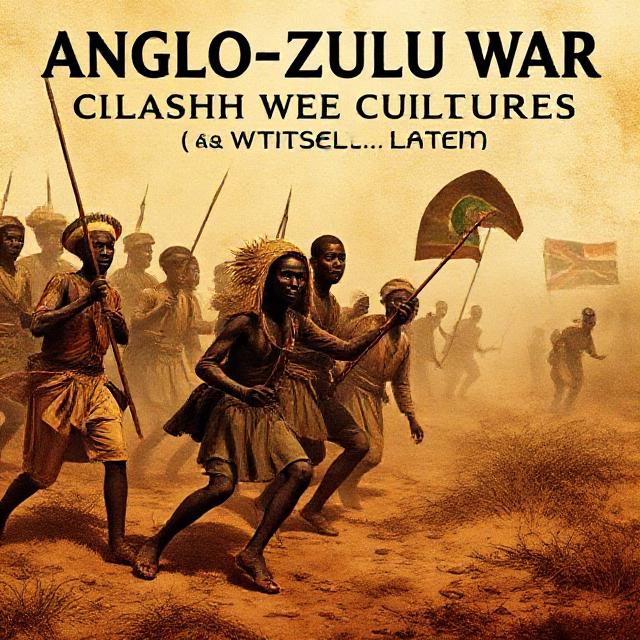
Introduction: When Empires Collided with Kingdoms
The Anglo Zulu War of 1879 stands as one of the most remarkable and tragic conflicts in African history. It was not simply a war between soldiers but a clash of civilizations, a confrontation between the powerful British Empire at the height of its colonial influence and the proud Zulu Kingdom whose warrior traditions and independence had made it one of the strongest African states of its time.
Fought across the hills and valleys of South Africa, the war reflected the tension between a rapidly expanding empire and an indigenous kingdom determined to defend its way of life. The Anglo Zulu War revealed the brutality of colonial expansion, the resilience of African resistance, and the deep consequences of cultural misunderstanding.
Background: The Roots of Imperial Ambition
By the late nineteenth century, Britain’s control in southern Africa had grown significantly. The British had already colonized the Cape Colony and Natal, building trading posts, missionary centers, and settlements. Their larger goal was to unify the region under British authority and create a confederation of territories similar to what had been done in Canada.
However, the Zulu Kingdom under King Cetshwayo kaMpande stood in the way. The Zulus commanded large territories, maintained a disciplined military, and remained an independent African state unwilling to submit to foreign power.
Sir Henry Bartle Frere, the British High Commissioner, saw the Zulu state as a threat to Britain’s regional ambitions. Border disputes and minor skirmishes along the Natal frontier were exaggerated to justify a confrontation. In December 1878, Frere sent an ultimatum to King Cetshwayo demanding that the Zulu army be disbanded and that the Zulu monarchy accept British oversight. These demands were impossible to meet, and war became inevitable.
Zulu Society and Military Organization
To understand the war, one must first understand Zulu society. The Zulu Kingdom had been forged in the early nineteenth century by King Shaka Zulu, who created a disciplined and organized military system.
The Zulu army, called the impi, was divided into regiments or amabutho based on age and experience. Warriors were trained with strict discipline and bound by loyalty to their king. Shaka transformed Zulu warfare by introducing new weapons such as the short stabbing spear known as the iklwa and the large cowhide shield called the isihlangu.
The Zulu used a famous tactic known as the horns of the bull. The center, or chest, engaged the enemy directly, while the horns moved around to encircle them, and the loins waited in reserve. This formation allowed the Zulu army to attack swiftly and decisively.
By the time King Cetshwayo came to power in 1873, the Zulu military system remained one of the most powerful indigenous forces in Africa. Although armed mainly with spears and shields, they were fierce, fast, and highly coordinated.
The British War Machine and Colonial Confidence
The British, in contrast, represented the modern industrial style of warfare. Their soldiers carried Martini Henry rifles, artillery, and rocket launchers. Backed by the resources of a global empire, they were confident of an easy victory.
The British invasion force consisted of regular army regiments, colonial volunteers, and African auxiliaries commanded by Lord Chelmsford. His plan was to divide the army into several columns and invade Zululand from different directions in January 1879.
Overconfidence and poor intelligence would soon lead to disaster. The British underestimated the Zulu fighting spirit and failed to prepare for the possibility of a large coordinated counterattack.
The Invasion Begins
On 11 January 1879, the British army crossed the Tugela River into Zulu territory. The main invasion column under Lord Chelmsford advanced toward the Zulu capital at Ulundi.
Chelmsford expected the Zulus to retreat when faced with British firepower. Camps were set up carelessly, and supply lines stretched thin. The Zulus, however, had no intention of surrendering their land without a fight.
King Cetshwayo had instructed his generals to avoid open conflict at first, hoping for a diplomatic settlement. But once British troops entered Zululand, his warriors could not be restrained.
The Battle of Isandlwana
On 22 January 1879, the British army suffered one of its worst defeats in colonial history near the mountain of Isandlwana.
Lord Chelmsford had split his forces, leaving part of the army camped while he moved ahead to scout for the enemy. Believing the Zulus were far away, the camp was poorly defended. In reality, a Zulu force of more than twenty thousand warriors was hidden nearby.
When a British patrol stumbled upon them, the Zulus launched a massive assault using their traditional horns formation. The British fought bravely but were soon overwhelmed. Their ammunition supplies failed, and panic spread through the camp.
By afternoon, more than thirteen hundred British and colonial soldiers were dead. The Zulu victory at Isandlwana shocked the world and destroyed the myth of European invincibility.
The Defense of Rorke’s Drift
On the same day as Isandlwana, a small British garrison at Rorke’s Drift faced a desperate battle for survival.
Only about one hundred and fifty soldiers, including engineers and hospital patients, were defending a small mission station. They were attacked by a Zulu force of four thousand warriors. Under the command of Lieutenants John Chard and Gonville Bromhead, the defenders built barricades from mealie bags and wooden crates.
For twelve hours, the British held off repeated Zulu attacks with steady rifle fire. When dawn came, the defenders were still standing. More than three hundred Zulu warriors were dead, and seventeen defenders had been killed.
Rorke’s Drift became one of the most celebrated defenses in British military history and restored some of the pride lost at Isandlwana.
Retaliation and the Second Invasion
The defeat at Isandlwana caused outrage in Britain. Newspapers demanded revenge, and fresh troops were sent to South Africa.
By March 1879, Lord Chelmsford had reorganized his army and prepared for a second invasion. This time the campaign was cautious and heavily armed.
The British won several victories at Gingindlovu and Eshowe, where their superior firepower decimated the attacking Zulu forces. The outcome of the war was now certain.
The Battle of Ulundi
The final and decisive battle took place at Ulundi on 4 July 1879. Lord Chelmsford led a force of more than five thousand men toward the Zulu capital.
King Cetshwayo gathered twenty thousand warriors for one last stand. The British formed a hollow square with Gatling guns and artillery at the corners. When the Zulus attacked, they were met by continuous gunfire and shelling.
Within an hour, the Zulu army was destroyed. Over fifteen hundred Zulus were killed, while British losses were minimal. The Zulu capital was burned to the ground, marking the end of the kingdom.
Cetshwayo was captured a month later and sent into exile, first to Cape Town and later to London. He was allowed to return a few years later but found his kingdom divided and weakened.
Aftermath: The End of Zulu Independence
The British victory brought an end to Zulu independence. The kingdom was broken into thirteen smaller territories ruled by local chiefs loyal to Britain. This division caused internal conflicts and destroyed the unity that had once made the Zulus powerful.
Although Cetshwayo briefly regained his throne, the Zulu Kingdom never recovered. By 1887, Zululand had been annexed to the British colony of Natal.
The war also taught Britain a hard lesson. The defeat at Isandlwana exposed the dangers of arrogance and poor planning in colonial warfare.
Cultural Misunderstandings and the Clash of Worlds
The Anglo Zulu War was not only a struggle for land and power but also a clash of very different worldviews.
For the Zulus, war was a matter of honor, tradition, and loyalty. For the British, it was an act of empire and industry. Both sides misunderstood each other completely. British leaders saw Zulu diplomacy as defiance, while the Zulus saw British demands as insults to their sovereignty.
This inability to understand each other’s culture and motives made war unavoidable.
Legacy and Historical Importance
The Anglo Zulu War remains one of the most studied colonial wars in history. It showed that even the most powerful empires could face defeat when underestimating indigenous resistance.
For the Zulu people, it became a symbol of courage and sacrifice. For Britain, it was both a story of tragedy and of redemption. The battles of Isandlwana and Rorke’s Drift became legendary and were later depicted in books and films such as Zulu and Zulu Dawn.
The war also shaped the future of South Africa. It paved the way for British domination of the region and laid the foundations for future conflicts over power and identity.
Conclusion: A War That Changed History
The Anglo Zulu War was more than a military conflict. It was a meeting of two civilizations with vastly different beliefs and ambitions. It showed the human cost of empire and the enduring strength of a people determined to defend their land.
Although the Zulu Kingdom was defeated, the spirit of its people survived. Their courage continues to be remembered as one of the most powerful examples of resistance in African history. The story of the Anglo Zulu War reminds the world that when empires rise and cultures collide, history itself is transformed.